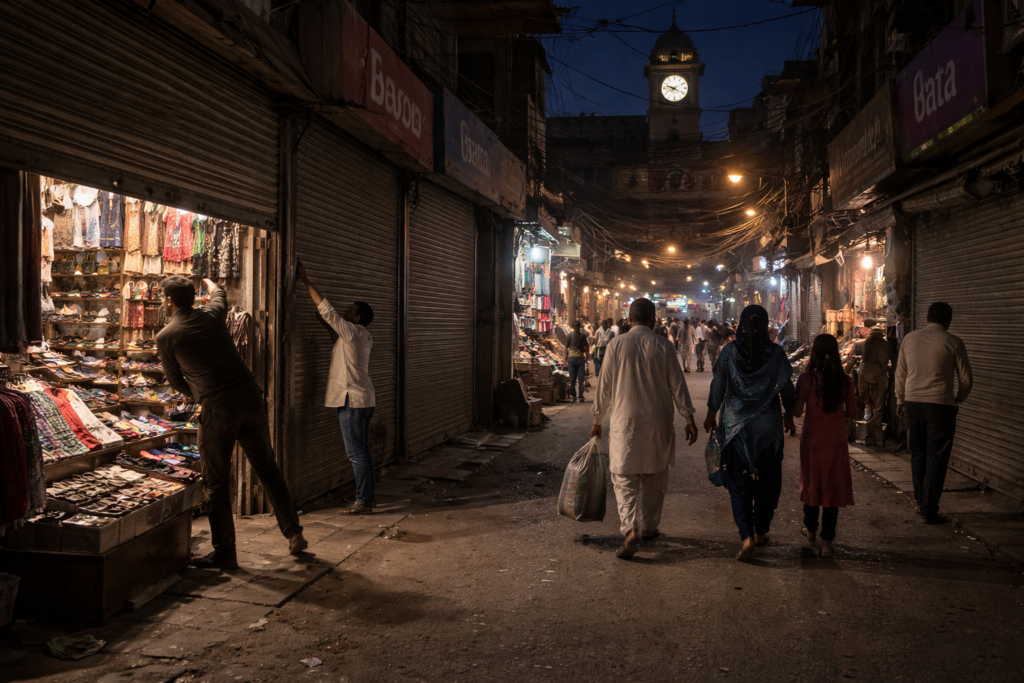
The government’s decision to shut markets between 8:00 PM and 9:00 PM has triggered a sharp decline in formal retail activity, with sales falling by 25 to 30 percent across nearly 35,000 outlets, according to industry representatives.
Retailers estimate the move is causing a weekly loss of around Rs. 100 billion in documented economic activity, while also squeezing incomes and forcing businesses to reduce second-shift staff.
The early closure policy was introduced as part of efforts to lower electricity consumption, encourage earlier shopping hours, and reduce strain on the national power grid. However, business leaders argue that the measure has failed to curb overall consumption and has instead pushed commercial activity into later hours and the undocumented sector.
Chain store representatives say customer footfall remains strong after 7:00 PM, while informal markets continue operating late into the night. As a result, they warn that the policy is shifting sales away from the formal economy, reducing tax collection from general sales tax and income tax linked to point-of-sale systems.
Retailers also contend that the expected energy savings have remained limited because restaurants, malls, and entertainment venues continue to operate, while more efficient and documented retail businesses are being forced to close earlier.
Industry officials have cautioned that around 13,000 businesses integrated with POS systems are now at risk as reduced operating hours continue to erode recorded sales. In response, they have proposed extending market closing hours to 10:00 PM to better reflect consumer shopping patterns and regional business practices.
They have also called for uniform operating hours across retail, restaurant, and entertainment sectors to prevent market distortions. Another proposal under consideration is the introduction of daylight saving time, which business leaders say could save an estimated $500 million annually in energy costs.
The concerns come at a time when inflationary pressures are mounting. Analysts expect inflation in April to rise to 10.2 percent year-on-year, up from 7.3 percent in the previous month. Retailers say weakening consumer purchasing power is already forcing buyers toward cheaper and lower-quality products, while concerns over further price increases continue to grow amid global tensions.