



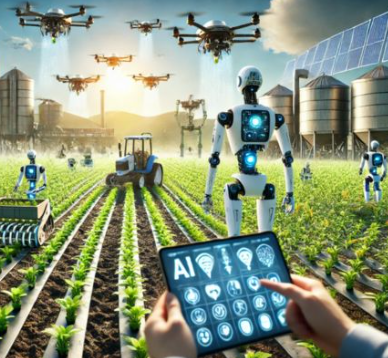
The Punjab government is preparing to introduce artificial intelligence tools for farmers, with plans to use technology and data to help them estimate crop yields and improve productivity.
Parliamentary Secretary Osama Leghari said the government wants to establish the groundwork for farmers to access AI within the remaining two and a half years of its tenure.
Speaking at the Pakistan Agricultural Coalition’s Agri Connections Conference and Expo in Lahore, he said Punjab was focusing on greater use of data and technology in agriculture.
Leghari said the government wants farmers to eventually use AI to forecast their yields and productivity.
He said the provincial government has also declared the current period as the “Year of the Value Chain” and is encouraging businesses to work directly with farmers to improve and add value to agricultural products.
Advisor to the Federal Finance Minister Adnan Pasha said climate change and population growth are among Pakistan’s major long-term challenges, with both affecting food, water and wider economic security.
He said Pakistan’s population could reach 370 million to 390 million over the next two decades and argued that agricultural transformation could not be funded by the government alone.
Pasha called for greater private-sector participation, with the government providing the necessary policy environment and mechanisms to share investment risks.
He said the World Bank’s new country partnership framework for Pakistan includes agriculture and climate-related priorities, covering areas such as water management, food security and climate resilience.
Pasha identified climate-resilient seeds as one area where private investment could support the development, testing, processing and distribution of varieties capable of withstanding heat, drought, floods and diseases.
He also stressed the need to improve water use on farms, saying long-term food security would require more efficient irrigation and farming practices.
Pakistan Agricultural Coalition CEO Kazim Saeed said the agriculture sector needs stronger leadership as Pakistan continues to import commodities such as wheat, cotton and lentils despite producing them domestically.
He added that agricultural exports remain below their potential, partly because of competitiveness and food safety issues.
World Bank Lead Agriculture Specialist Olivier Durand said Pakistan’s farming sector remains highly fragmented, with many small farmers lacking direct links to markets, processors and buyers.
He said this limited market access remains a challenge for both food security and agricultural trade.
Durand also said around 60 percent of Pakistan’s population faces difficulty affording a healthy diet, despite the country having significantly increased agricultural production over the past three decades.
The conference also included discussions on food security, agricultural input markets and the deregulation of supply chains, with participation from the World Bank, OCP Morocco, Syngenta Pakistan and the International Finance Corporation.