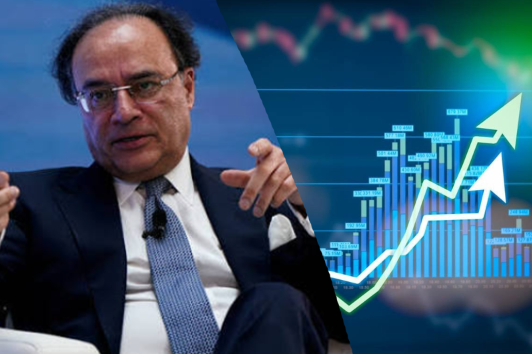
Finance Minister Muhammad Aurangzeb has said Pakistan has moved from economic stabilization toward growth, but the next phase will depend on investment, exports, productivity and private-sector activity.
Speaking at the Overseas Investors Chamber of Commerce and Industry (OICCI) in Karachi, Aurangzeb said the government’s priority was to make recent economic stability permanent and prevent a return to the country’s repeated boom-and-bust cycles.
He said economic expansion should not depend on temporary liquidity or higher consumption. Instead, investment, exports, productivity and job creation should become the main drivers of growth.
Aurangzeb said the government would focus on policy continuity, structural reforms and improving the business environment, while the private sector would have to take the lead in investment and economic expansion.
He cited the PIA transaction as an example of the capacity of local investors, saying Pakistani business groups had collectively mobilized nearly $1.2 billion.
The Finance Minister also pointed to growing foreign investor interest in mining and minerals, technology, agriculture, oil and gas and refinery upgrades. He said Turkish investors were interested in the privatization of electricity distribution companies, while Saudi and other international investors were also exploring opportunities.
On tax reforms, Aurangzeb said the number of tax filers had exceeded 5.7 million, compared with around 3.9 million a year earlier and roughly 1.8 to 1.9 million in 2022.
He said the government would continue expanding the tax base while using digital systems and data to improve tax administration and taxpayer facilitation.
Aurangzeb also highlighted efforts to increase financing for small and medium-sized enterprises, agriculture and housing. He said around Rs60 billion had already been financed under the Prime Minister’s Apna Ghar Programme, with further financing approved by banks.
He said Pakistan also needed deeper capital markets so domestic savings could be used for infrastructure, housing, privatization and private-sector investment.
The Finance Minister said Pakistan was also looking to increase trade and investment links with other countries and reduce reliance on aid.
He identified digitalization, blockchain, Web 3.0 and emerging technologies as areas that could create new opportunities for investment, exports and employment.
Aurangzeb said the government would focus on economic governance and policy stability while the private sector would be expected to drive investment and productive activity.