




Artificial intelligence tools are getting cheaper globally, but they remain far more expensive for Pakistani workers when measured against local incomes.
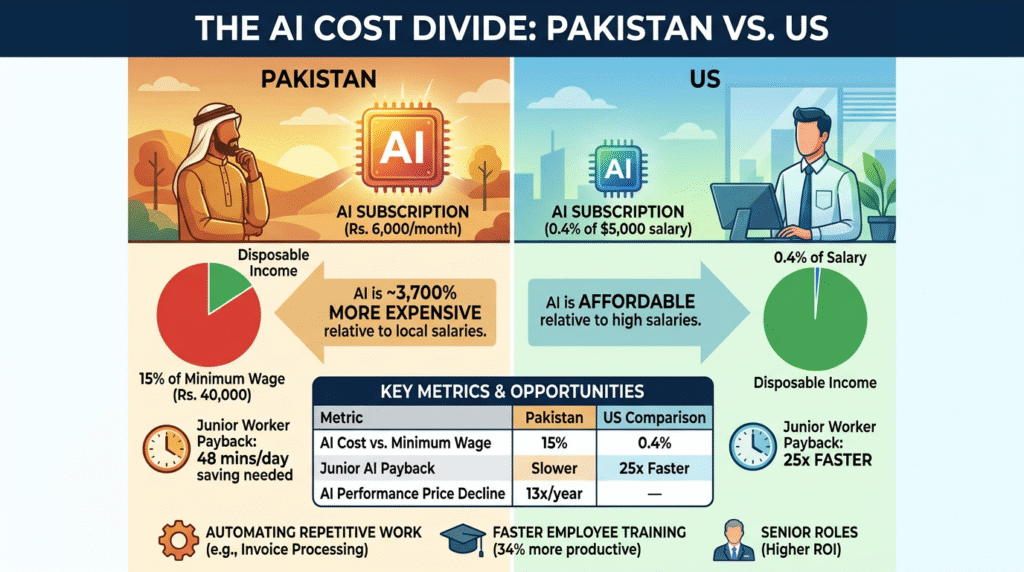
A new analysis by Densight Labs estimates that an AI subscription costing around Rs. 6,000 per month consumes 15 percent of Punjab’s Rs. 40,000 minimum wage. In comparison, the same monthly cost would represent about 0.4 percent of an illustrative $5,000 monthly salary in the US.
On this income-adjusted basis, the analysis estimates that AI is around 3,700 percent more expensive in Pakistan.
| Metric | Pakistan/Lahore | US Comparison |
|---|---|---|
| AI subscription | Rs. 6,000/month | 0.4% of $5,000 salary |
| AI cost vs minimum wage | 15% | 0.4% |
| Junior worker payback | Much slower | Around 25x faster |
| AI performance cost decline | Around 13x per year | — |
The difference becomes particularly important for companies deciding who should receive paid AI tools.
A junior worker earning Rs. 60,000 per month would need to save roughly 48 minutes of work each day to recover a Rs. 6,000 monthly subscription. For a department head earning Rs. 500,000, the required time saving falls to around six minutes a day.
This suggests that giving every employee an expensive AI subscription may not make financial sense in Pakistan, particularly for lower-paid workers.
Where AI Can Pay Off
The economics become more attractive when AI is used by higher-paid employees or for repetitive tasks.
For example, if AI makes 30 percent of a department head’s work 25 percent faster, the time saved by an employee earning Rs. 500,000 could be worth around Rs. 37,500 a month. Against a Rs. 6,000 subscription, that represents a potential return of roughly six times the monthly cost.
AI can also shorten the time needed for new employees to become productive.
The analysis cites research involving more than 5,000 support workers that found new employees using AI became 34 percent more productive. Workers with two months of experience were also able to reach the productivity level of employees with six months of experience.
For a worker earning Rs. 60,000 per month, cutting four months from the learning period could represent around Rs. 120,000 in additional output, compared with about Rs. 72,000 for a full year of the AI subscription.
Automation provides another opportunity.
Densight estimates that processing an invoice manually costs a minimum-wage worker around Rs. 9, while AI could perform the initial extraction for less than Rs. 3 under the assumptions used in its analysis. The employee could then focus on checking exceptions and handling more complicated cases.
Cheap AI Does Not Guarantee Savings
There is also a major risk in using AI for tasks it cannot handle reliably.
The analysis cites research showing that consultants using AI outside its capabilities were 19 percent less likely to produce a correct answer. It also points to an MIT estimate that only around 5 percent of organizations have converted enterprise AI adoption into measurable financial gains.
At the same time, AI itself is becoming dramatically cheaper. Densight estimates that the cost of a fixed level of AI performance has fallen by around 13 times per year since 2023.
For Pakistan, however, falling global AI prices may not solve the immediate problem. Most major AI services are priced in dollars while salaries are earned in rupees.
This could also affect Pakistan’s outsourcing industry. The country’s call centre and business process outsourcing exports crossed $300 million during the first 11 months of FY2025-26, leaving labour-intensive services exposed as AI becomes capable of handling more routine tasks.
The economics therefore point to a targeted approach. Pakistani companies may get more value by giving AI tools to employees and processes where the time or cost savings clearly exceed the subscription price.
The key question is not whether AI is useful. It is whether the AI tool can generate enough value in rupees to pay for itself.