Pakistan has formally requested a $10 billion exchange stabilization facility from the United States, a move aimed at strengthening the country’s foreign exchange reserves, supporting the rupee, and reducing its long-standing dependence on multilateral lenders, Reuters reported on Tuesday.
The request was reportedly made to US Treasury Secretary Scott Bessent and seeks a bilateral exchange stabilization support facility with a maturity of up to five years. If approved, the financing would provide Islamabad with an additional liquidity buffer as the country continues to implement economic reforms under its International Monetary Fund (IMF) programme.
The development follows Pakistan’s diplomatic engagement during the Iran conflict, which has raised expectations in Islamabad that the country could leverage its growing strategic importance to secure stronger economic cooperation with Washington.
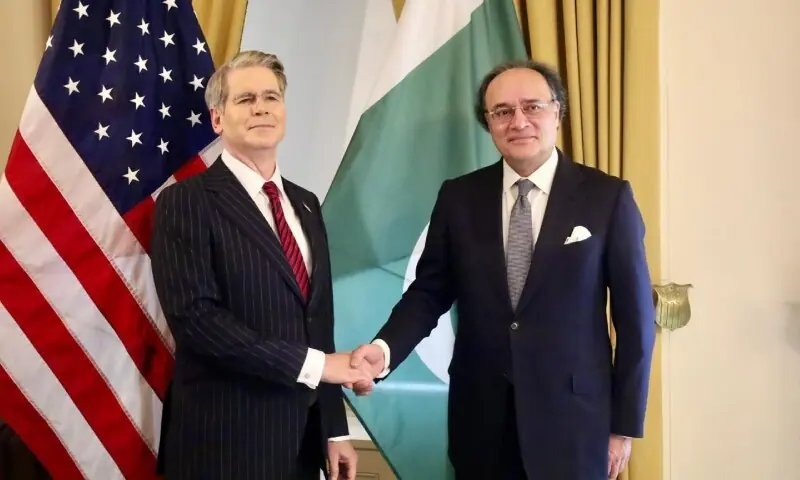
During a meeting in Washington on Tuesday, Finance Minister Muhammad Aurangzeb discussed Pakistan’s economic vulnerabilities arising from regional geopolitical developments with Secretary Bessent. While the Finance Ministry confirmed the meeting took place, it did not mention the reported request for the stabilization facility.
According to the ministry, Aurangzeb called for greater US support to help Pakistan improve access to international capital markets, increase foreign exchange reserves, and strengthen its sovereign credit profile. Both sides also reaffirmed their commitment to expanding bilateral economic cooperation, encouraging US investment, and advancing strategic projects.
The US Treasury declined to comment on the reported request, while Pakistan’s Finance Ministry did not immediately respond to Reuters’ request for additional comment.
A Fraught Economic Backdrop
The request comes against a backdrop of persistent external vulnerabilities. Pakistan remains under a $7bn IMF programme that requires fiscal discipline, tax reforms, and tighter monetary policies. The country narrowly avoided a sovereign default in 2023 after securing a $3bn IMF standby arrangement, before later obtaining a $7bn Extended Fund Facility and an additional $1.3bn climate resilience loan.
Despite these measures, the country’s external financing continues to rely heavily on official support from international partners, including China and Saudi Arabia.
Exchange stabilization facilities are uncommon financial arrangements provided through the US Treasury’s Exchange Stabilization Fund to help countries strengthen reserves and stabilize their currencies. Such an agreement would not only improve Pakistan’s external liquidity but also send a strong signal of US confidence in the country’s economic reforms.
Pakistan’s central bank expects foreign exchange reserves to reach nearly $20bn by the end of 2026, although risks from global energy prices, regional geopolitical tensions, and limited foreign investment continue to weigh on the country’s economic outlook.
The Political Cost of IMF-Led Stability
The IMF-backed reform programme has restored a measure of macroeconomic stability, but only through higher taxes, tight controls on spending, and a squeeze on the fiscal space available for development and welfare — measures that carry mounting political cost for the government.
The reforms have not gone unnoticed by ratings agencies. Fitch noted in April that Pakistan’s adherence to the IMF programme had bolstered its funding capacity, while rebuilt foreign exchange buffers offered a cushion against economic shocks emanating from the conflict in the Middle East.
Yet deeper vulnerabilities persist. The agency cautioned that rising energy costs and potential supply disruptions could sharply erode the country’s reserves. Foreign investment, meanwhile, has remained thin — deterred by recurring external crises, policy uncertainty, security risks, a history of profit-repatriation curbs, and a narrow export base. With its credit rating still lodged deep in speculative-grade territory, borrowing costs remain elevated and access to international markets constrained.
Leveraging the Trump Connection
Against this backdrop, Islamabad has sought to leverage its ties with the Trump administration to address some of these structural weaknesses. Economic cooperation between the two sides has so far extended across cryptocurrency, real estate and mining.
Pakistan has signed a stablecoin agreement for cross-border payments with an affiliate of World Liberty Financial, the main crypto venture of President Donald Trump’s family. It has also pursued a memorandum of understanding with the US government to redevelop the shuttered, Pakistan International Airlines-owned Roosevelt Hotel in New York, and has actively courted American mining investment — including in Reko Diq, where the US Export-Import Bank has announced $1.25bn in financing.
Taken together, these engagements point to a broader strategy: using warmer ties with Washington not merely for one-off deals, but as a possible pathway to the kind of financial backstop that could, over time, reduce Pakistan’s exposure to the boom-and-bust cycle of external crises.