




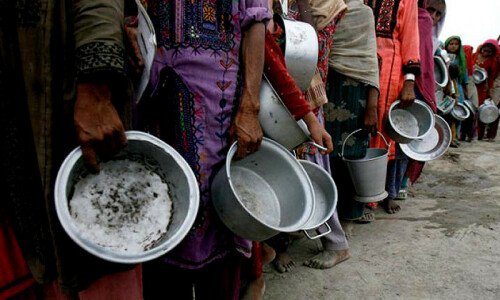
Pakistan has the second-highest hunger level in South Asia after Afghanistan, according to the 2026 Global Hunger Index (GHI), which classifies hunger in the country as serious.
Pakistan scored 25.5 out of 100 and ranked 106th among 122 countries with sufficient data. The findings highlight persistent food insecurity and widespread child malnutrition.
Although Pakistan’s hunger score has improved from 36.2 in 2000 to 25.5 in 2026, the country has lost ground in recent years. Its score increased from 24.0 in 2018 to 25.5 in 2026, making it one of only two South Asian countries, alongside Afghanistan, where hunger has worsened over this period.
The report estimates that 16.1 percent of Pakistan’s population is undernourished and does not receive enough calories. Among children under five, 33.6 percent suffer from stunted growth due to chronic undernutrition, while 9.8 percent experience wasting, which reflects acute undernutrition. The under-five mortality rate stands at 5.6 percent.
The report attributes Pakistan’s food security challenges to economic instability, high food prices and climate-related disasters. Heavy monsoon rains and flash floods in 2025 affected more than six million people, damaging farmland and infrastructure. Lower household purchasing power has also made it harder for people to afford adequate food.
Pakistan fares worse than most South Asian countries
South Asia recorded a hunger score of 23.5, the second-highest among global regions after sub-Saharan Africa, which scored 27.5.
Afghanistan recorded a score of 28.6, followed by Pakistan at 25.5 and India at 24.1. Bangladesh scored 19.2, Nepal 14.5 and Sri Lanka 10.2.
The report estimates that 218 million people across South Asia, including Iran, were undernourished between 2023 and 2025. This represents roughly one-third of the global total.
Despite improvements since 2000, the region has made limited progress since 2018. Undernourishment has remained largely unchanged, while child wasting has risen to 15.8 percent, the highest regional rate worldwide.
Global hunger is rising again
The global hunger score increased to 18.1 in 2026 from 17.6 in 2018, reversing some of the progress made since 2000, when it stood at 28.2.
The report links the deterioration to conflicts, extreme weather, economic shocks and disruptions to food and agricultural supply chains.
Hunger has worsened in 32 countries since 2018. A total of 36 countries face serious hunger levels, while eight have alarming levels. The report estimates that 645 million people worldwide were undernourished in 2025.
Rising food and transport costs, extreme weather, ongoing conflicts and cuts in humanitarian funding continue to put pressure on food supplies. The report also warns that a stronger El Niño could further threaten food security and nutrition in vulnerable regions.
The Global Hunger Index measures hunger using four indicators: undernourishment, child stunting, child wasting and child mortality. The 2026 findings draw on data covering the 2021 to 2025 period.