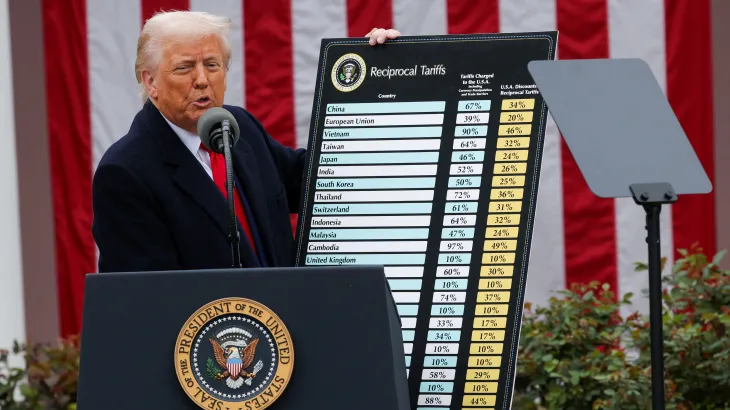
The United States has announced a 10 per cent tariff on imports from Pakistan as part of a sweeping trade action targeting 60 countries over concerns related to forced labour practices, the Office of the US Trade Representative confirmed.
The new duties, effective Friday, range from 10 to 12.5 per cent and replace a temporary global tariff introduced earlier this year by President Donald Trump. Pakistan joins India, Canada, Bangladesh, Malaysia, Mexico, Indonesia, Jordan, Sri Lanka and the United Kingdom in facing the lower rate, while China and 37 other countries will be subject to a 12.5 per cent duty.
US Trade Representative Jamieson Greer said the measures were designed to push trading partners to strengthen enforcement against forced labour, noting that the United States has long maintained restrictions on imports produced under such conditions.
The tariffs follow a months-long investigation by the USTR and are expected to be more resilient to legal challenges than Trump’s earlier tariff actions, several of which were struck down by the US Supreme Court in February. The temporary 10 per cent tariff imposed after that ruling expires on Friday.
Pakistan submitted detailed responses to the USTR during the investigation, including a separate submission ahead of bilateral trade talks earlier this month that addressed the forced labour concerns raised by American authorities.
The move has drawn sharp criticism from several US trading partners. Japan expressed regret over the decision, while Australia’s trade minister described the duties as unjustified and inconsistent with the countries’ free trade agreement.
The new measures will not apply to goods already covered by sector-specific tariffs, including steel and aluminium. Certain energy products, fertilisers, and goods covered under the US-Mexico-Canada Agreement (USMCA) are also exempt.
The Trump administration is also investigating 16 economies over excess industrial capacity, raising the prospect of additional tariffs in the coming months. Trade experts say the latest measures reinforce Washington’s increasingly protectionist posture while giving the administration leverage in future negotiations with key trading partners.