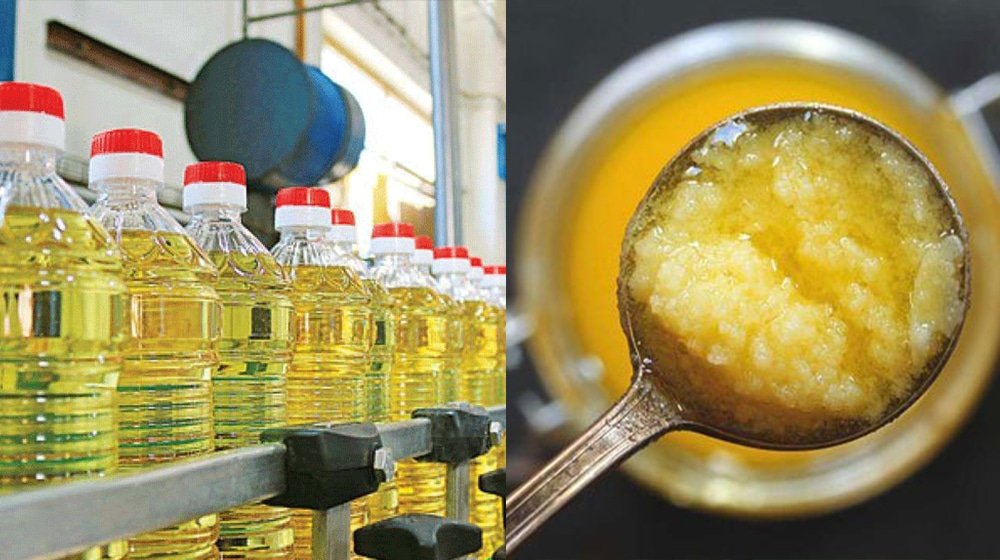
The federal government has ordered a nationwide assessment of loose edible oil, ghee, and milk after laboratory testing found that more than one-third of packaged food samples failed to meet Pakistan’s quality standards.
The directive was issued during a meeting of the National Price Monitoring Committee (NPMC), chaired by Planning Minister Ahsan Iqbal. He instructed provincial governments, regional administrations, and relevant regulatory agencies to carry out a scientific survey of unpackaged edible oil, ghee, and milk being sold across the country.
The move follows laboratory testing of 491 packaged food samples by the Pakistan Council of Scientific and Industrial Research (PCSIR), with the consolidated results compiled by the Pakistan Standards and Quality Control Authority (PSQCA).
According to the findings, 315 samples complied with national standards, while 176 failed, resulting in a non-compliance rate of nearly 36 percent.
The highest failure rate was recorded in banaspati ghee, where 98 out of 204 samples did not meet quality standards. The tests also found non-compliance in 40 of 146 blended cooking oil samples, 26 of 104 packaged liquid milk samples, 8 of 18 milk powder samples, 3 of 4 refined palm oil samples, and 1 of 13 refined canola oil samples.
To review the findings, the planning minister constituted a technical subcommittee comprising experts from the Ministry of Planning, PCSIR, and PSQCA. The committee has been tasked with evaluating the laboratory results and recommending regulatory and policy measures.
The NPMC also reviewed the country’s inflation outlook and was informed that headline inflation eased to 9.2 percent in July 2026, down from 11.1 percent in June.
Officials told the committee that natural gas remained the largest contributor to inflation, followed by housing, wheat flour, fresh milk, and petrol. Meanwhile, lower prices of sugar, potatoes, and chicken helped ease overall price pressures.
Iqbal also directed provincial governments and district administrations to investigate large price gaps between wholesale and retail markets for essential commodities and propose measures to improve market transparency and strengthen consumer protection.