Federal Board of Revenue (FBR) Chairman has argued that repeatedly weakening the Pakistani rupee will not automatically solve the country’s trade deficit, using a Mulla Nasruddin story to explain his point.
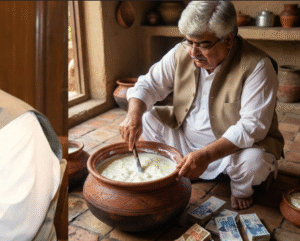
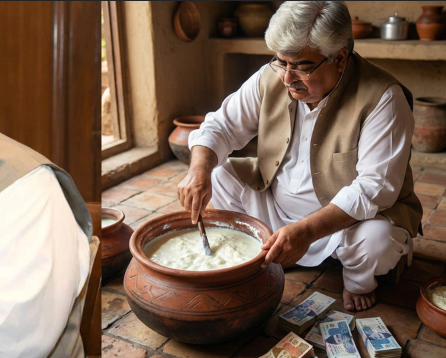
In a detailed note, he compared the strategy to trying to make yogurt by mixing a spoonful of yogurt into a lake of water. The idea may sound reasonable, he said, but the basic conditions needed for it to work are missing.
The same applies to Pakistan’s currency policy, according to the FBR chairman. A weaker PKR is expected to make Pakistani exports cheaper in international markets while making imports more expensive, helping narrow the trade gap.
However, he said Pakistan’s economy has a high dependence on imported inputs, meaning a weaker currency also raises the cost of producing goods for export.
He gave the example of Pakistan’s textile industry, where imported cotton, dyes, machinery components and fuel account for a significant part of production costs. This limits the benefit exporters receive from a weaker rupee.
The FBR chairman also pointed to Pakistan’s import structure. Oil and gas make up a major portion of the import bill, while the country also imports food items, medicines and other essential products. Higher import prices therefore put additional pressure on domestic costs when the PKR loses value.
He said the impact on exports is also limited because a large share of Pakistan’s exports comes from textiles. A weaker currency does not necessarily create enough additional demand to significantly expand exports.
Another problem, according to the FBR chairman, is inflation. The initial advantage of a weaker PKR can gradually disappear as higher import costs feed into prices of food, fuel and electricity.
He also highlighted the role of overseas Pakistanis. Remittances increase in rupee terms when the PKR weakens, but much of this money is ultimately spent on consumer goods, including imported products, rather than being directed toward productive investment.
The FBR chairman cited examples from Britain, South Korea, Egypt and Pakistan to show that currency depreciation has produced different results depending on the underlying structure of an economy.
He said Pakistan needs to reduce the imported content of its exports, improve domestic production, lower protection for the local market and encourage remittances toward investment in productive activities.
He also referred to the J-curve effect, under which a country’s trade balance can initially worsen after a currency depreciation before improving later.
His central argument was that PKR devaluation cannot deliver lasting improvement on its own. Pakistan first needs an economy capable of producing competitive export goods with a greater share of domestic inputs.
In his analogy, the spoonful of yogurt represents currency devaluation, while the milk pot represents the economic structure needed to turn a weaker currency into stronger exports. Without that foundation, he argued, repeatedly weakening the PKR will not produce the desired result.