



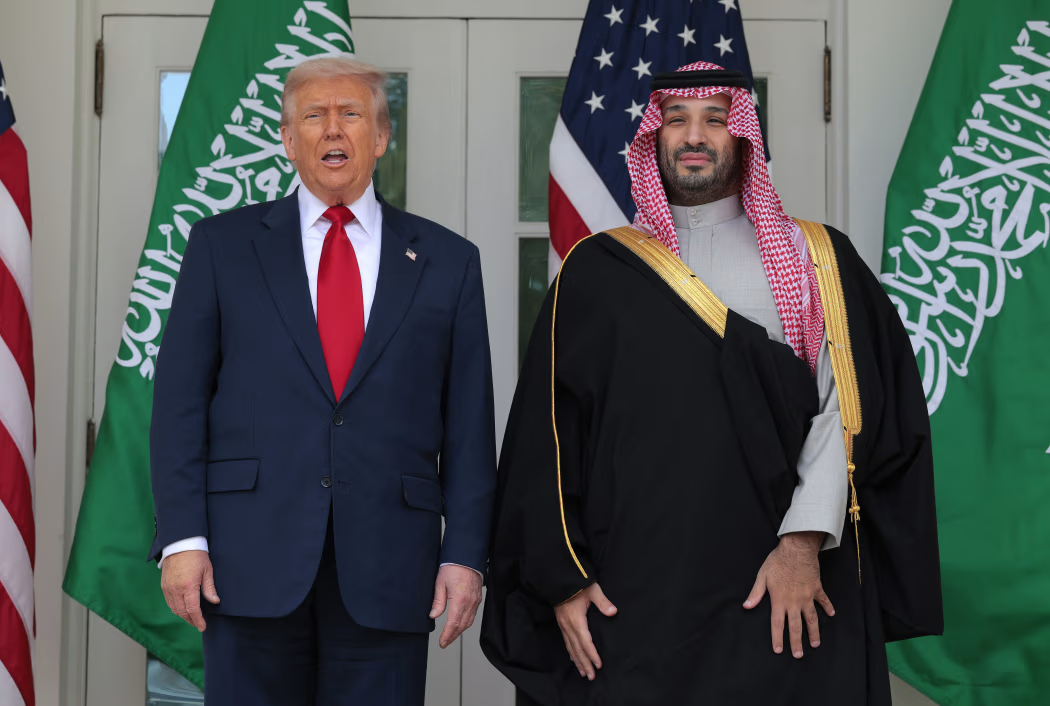
President Donald Trump has approved a landmark civilian nuclear cooperation agreement with Saudi Arabia that could allow uranium enrichment inside the kingdom under American oversight, The Wall Street Journal reported, citing Trump administration officials.
The proposed 30-year agreement, valued at tens of billions of dollars, is designed to give American companies a leading role in developing Saudi Arabia’s civilian nuclear infrastructure while limiting the involvement of rival foreign suppliers. US Energy Secretary Chris Wright and Saudi Energy Minister Prince Abdulaziz bin Salman are expected to sign the deal on Wednesday, after which it will be submitted to Congress for review.
At the heart of the agreement is a joint US-Saudi study to determine whether uranium enrichment in the kingdom is commercially viable. If the study supports the proposal, American companies would build and operate the enrichment facility under a “black box” arrangement designed to prevent the transfer of sensitive nuclear technology to Saudi hands.
US officials said the arrangement would allow Washington to oversee the program and help ensure that enriched uranium is used exclusively for peaceful purposes. Should the United States decide not to proceed with the enrichment project after the study, Saudi Arabia would be barred from pursuing enrichment independently or with another foreign partner for a period of 10 years.
American industry set to benefit
Supporters argue the agreement could strengthen US-Saudi relations, revive the American nuclear industry, and curtail Russian and Chinese influence in the kingdom’s energy sector. Westinghouse Electric is expected to be among the biggest beneficiaries, with its AP1000 nuclear reactor likely to play a central role in the program.
Nonproliferation concerns and a shift from Biden-era policy
The proposal has drawn sharp criticism from nonproliferation experts and lawmakers, who warn that allowing uranium enrichment in Saudi Arabia could encourage other Middle Eastern countries to pursue similar capabilities, heightening the risk of nuclear proliferation. Concerns have also been raised over Saudi Arabia’s refusal to adopt the International Atomic Energy Agency’s Additional Protocol, which permits more extensive international inspections.
The agreement also marks a significant departure from the approach of former President Joe Biden, who had linked nuclear cooperation with Saudi Arabia to the kingdom’s normalization of relations with Israel. The Trump administration has removed that condition, even as Washington continues to pressure Iran to curb its nuclear program and surrender its stockpile of highly enriched uranium.
US officials maintain that the proposed agreement includes robust safeguards to ensure the program remains exclusively civilian and complies with international nonproliferation standards. If Congress does not block the deal, it could become one of the most significant US-Saudi strategic partnerships in decades.