




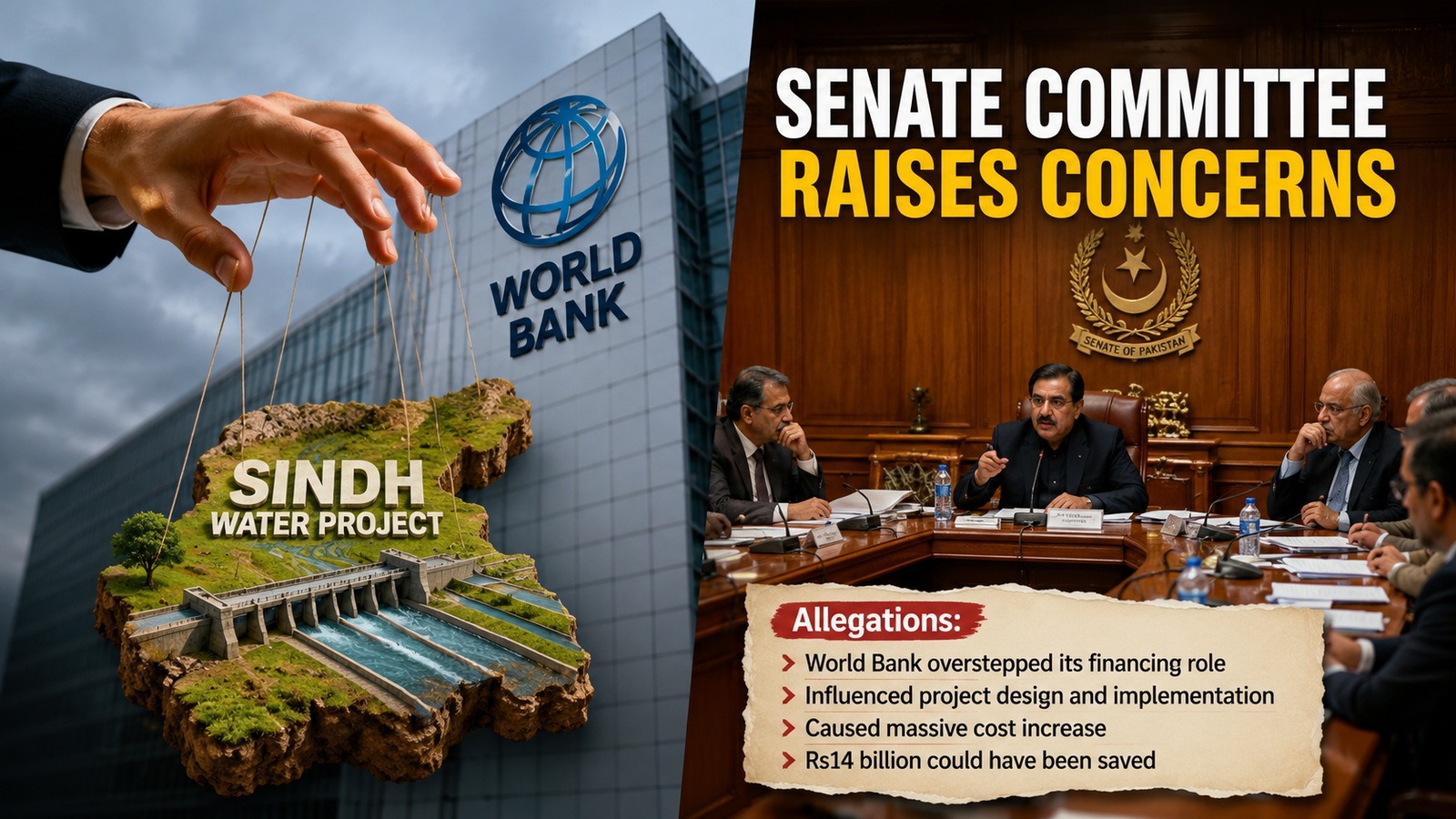
A Senate committee has alleged that the World Bank’s involvement in the Sindh Water and Agriculture Transformation Project resulted in unnecessary design changes that could cost Pakistan nearly Rs14 billion, while questioning whether the lender exceeded its role as a financier.
The Senate Standing Committee on Economic Affairs, chaired by Senator Saifullah Abro, reviewed a number of foreign-funded development schemes on Friday, including the Sindh Water and Agriculture Transformation Project.
During the meeting, Senator Abro questioned the role of the World Bank’s local representatives, arguing that a financing institution can decide whether to fund a project but should not influence its technical design or implementation. He said responsibility for project planning rests with Pakistan’s relevant authorities.
Abro further alleged that modifications made under external influence had inflated the project’s cost. According to him, retaining the original design could save the national exchequer around Rs14 billion. He also said Pakistan should not accept what he described as external “blackmail” in the execution of development projects.
Officials briefing the committee acknowledged that the project’s estimated cost had increased significantly. The Chairman of the Planning and Development Department informed lawmakers that the revised cost was approaching double the project’s original estimate.
The committee chairman also cited the Peshawar–Torkham project, alleging that Pakistan had previously faced similar issues over financing conditions. He said the committee had intervened in that case to protect the country’s financial interests and stressed that the same approach should be adopted again.
After deliberations, the committee instructed the Economic Affairs Division to formally engage with the World Bank and arrange a meeting to discuss the concerns raised by lawmakers.
The World Bank’s position on the allegations was not presented during the committee proceedings.