



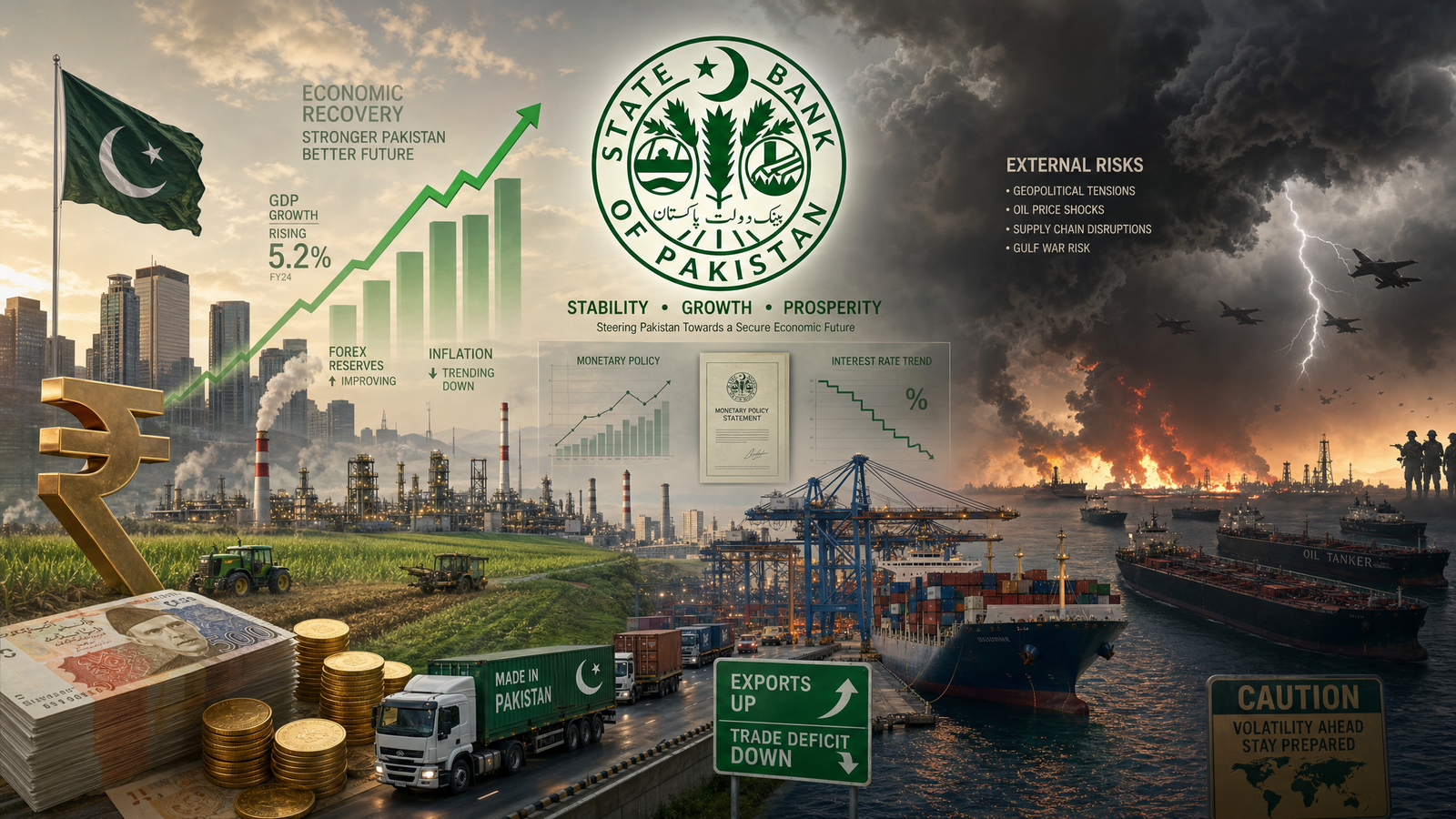
Pakistan’s economy showed further improvement in the first half of FY26, with key indicators reflecting stronger stability despite global uncertainty and domestic challenges, according to the State Bank of Pakistan’s latest half-year report. The central bank noted that external risks, including geopolitical tensions in the Middle East, could still affect inflation, trade flows, and economic activity in the coming months.
The report highlighted that inflation continued to ease during the period, while foreign exchange inflows and central bank purchases helped strengthen external reserves. Economic performance was supported by a mix of cautious monetary policy, fiscal discipline, structural reforms, stable global commodity prices, and ongoing support from the IMF program. The government also recorded a fiscal surplus during H1 FY26, aided by lower debt servicing costs and tighter spending controls.
On the growth side, real GDP expanded at nearly twice the pace of the same period last year, driven mainly by industrial activity, followed by services and agriculture. Higher import volumes reflected rising economic activity, while weaker rice exports reduced export earnings. However, steady inflows from overseas workers helped offset external pressures and kept the current account deficit within manageable levels.
Average inflation stood at 5.2 percent, lower than last year, supported by stable exchange rates, reduced electricity tariffs, and easing global commodity prices. The fiscal balance also improved significantly, marking a rare surplus not seen in over two decades, while the primary surplus remained stable.
Despite the improvement, the report stressed that Pakistan still needs deep structural reforms to sustain long-term growth. Challenges such as low savings, weak investment, declining exports, limited foreign direct investment, and a low tax-to-GDP ratio continue to weigh on the economy.
The SBP also warned of climate-related risks, noting that Pakistan remains highly vulnerable to environmental shocks despite its low global emissions contribution. Limited funding for climate adaptation and mitigation further increases economic exposure.
Looking ahead, the central bank expects growth to remain positive but slightly lower than earlier projections due to external pressures. Inflation is likely to remain above the medium-term target range if global oil prices and commodity costs continue to rise, while geopolitical tensions could further impact the outlook.