



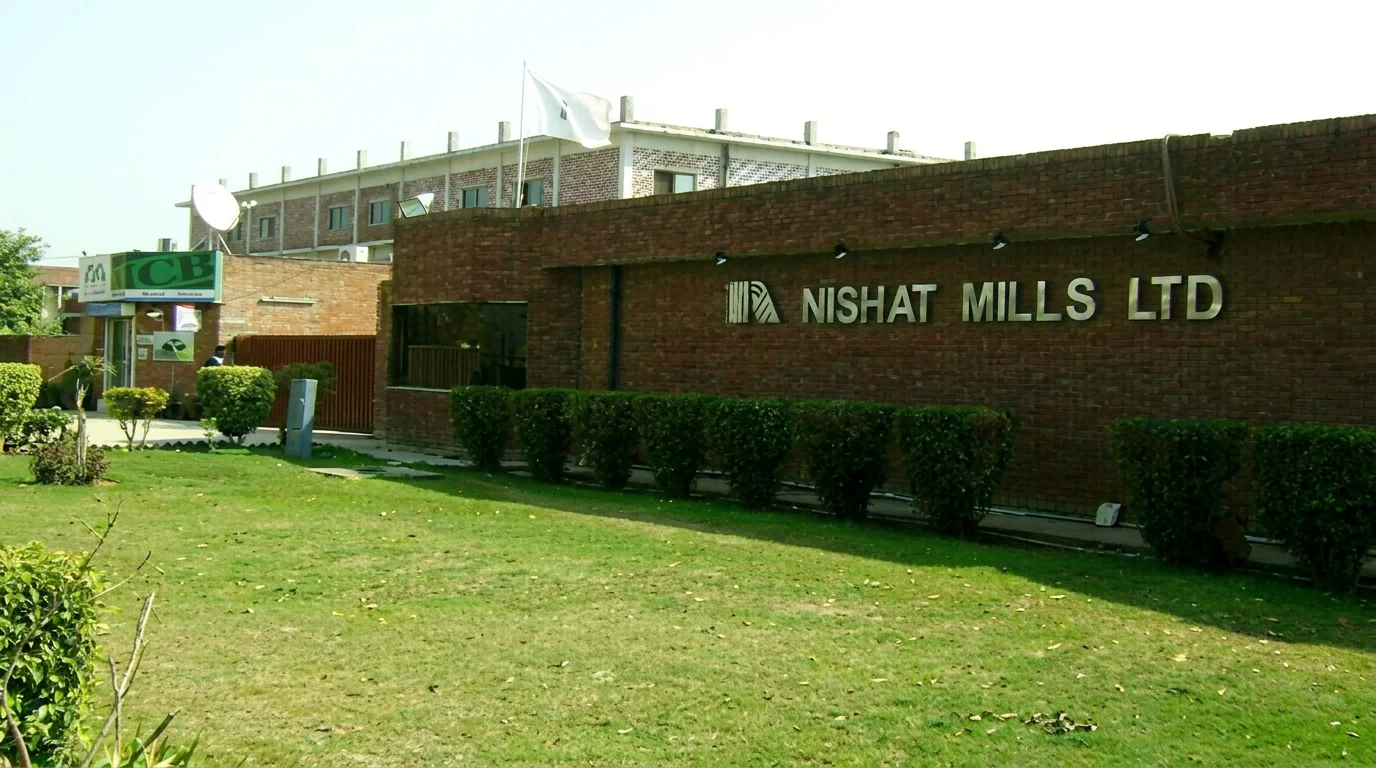
Nishat Mills Limited (NML) expects US tariffs to have a limited impact on its business, as the American market accounts for only 16 to 20 percent of its total exports, while a significant portion of its shipments goes to Europe under the Generalized System of Preferences Plus (GSP+) trade arrangement.
During its corporate briefing on November 27, management said the actual impact of US tariffs would depend on how international buyers shift orders between competing countries.
However, the company expects to gain only limited advantage from Pakistan’s comparatively lower US tariffs because of its substantial exposure to the European market.
Nishat Mills also expects Pakistan’s textile industry to remain resilient in 2027, with home textiles and garments, particularly higher value-added products, likely to perform better than other segments.
Nishat Mills Secures Cotton Supplies Until June 2027
The company imports around 38 to 40 percent of its cotton requirements, while the rest is procured from the domestic market.
Management expects imported cotton to account for approximately 40 percent of total requirements this year, mainly because of quality concerns surrounding locally available supplies.
Nishat Mills has already arranged its cotton procurement requirements through June 2027, providing greater visibility over raw material availability.
Its spinning business recorded healthy margins during the first half of FY27, supported mainly by gains from existing inventories. However, management expects profitability in this segment to face pressure during the second half.
Home Textiles and Garments Expected to Perform Better
Nishat Mills expects its denim business to recover gradually as it improves its product mix. However, weak demand in Europe remains a challenge.
Management expects the denim segment to reach breakeven by FY27. The workwear business continues to face difficulties and may require more time to return to profitability.
The company’s towel business is performing around industry averages, with prices ranging between $5.5 and $6 per pound. Meanwhile, its home textile products command prices approximately 20 percent above industry averages.
Nishat Mills also shared details of its energy mix, which comprises 54 percent grid electricity, 26 percent gas, 10 percent solar and 10 percent biomass. Management said its average electricity cost is not significantly different from grid-based power.
Rising Freight Costs Pose Limited Risk to Export Orders
The company expects higher sea freight costs and uncertainty in international order books to remain important challenges for textile exporters.
However, management believes the impact on Nishat Mills will be relatively limited because most of its export orders are booked on a free-on-board (FOB) basis. Under this arrangement, buyers generally bear the responsibility for freight costs.
The company’s export order book for value-added products currently provides visibility for approximately 90 days.
In terms of product composition, yarn contributes 30 percent of sales, followed by processed cloth at 16 percent, greige cloth at 21 percent, made-ups at 15 percent, garments at 10 percent and towels at 6 percent.
Geographically, Pakistan accounts for 39 percent of sales, Europe 24 percent and America 16 percent. Asia, Africa and Australia collectively contribute 16 percent, while direct exports from Pakistan account for the remaining 5 percent.
Topline Securities maintained a buy recommendation on Nishat Mills shares, which were trading at an estimated FY27 price-to-earnings ratio of 7.5 times.