India’s political confrontation is beginning to echo Pakistan’s recent experience, as opposition leader Rahul Gandhi challenges Prime Minister Narendra Modi’s government over constitutional protections, protests and the treatment of political dissent.
In a strongly worded post on X on Saturday, Gandhi said the space for Modi and his allies was closing, warning that arrests would not stop the opposition movement. He accused the ruling leadership of undermining India’s Constitution and called on young people to continue protesting.
Gandhi said he had spent more than a decade confronting Modi and the Rashtriya Swayamsevak Sangh (RSS), claiming he understood their political methods thoroughly. He also named Home Minister Amit Shah, RSS chief Mohan Bhagwat, Chief Election Commissioner Gyanesh Kumar and National Security Adviser Ajit Doval in his criticism.
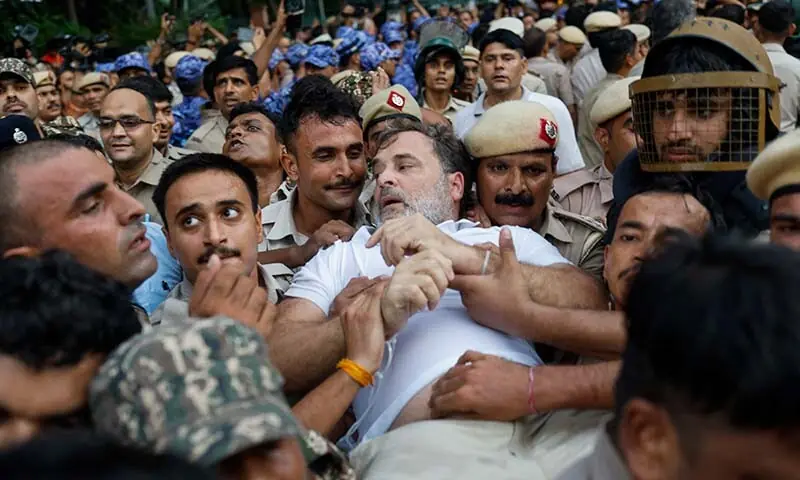
The opposition leader challenged the government to arrest as many protesters and political leaders as it wanted, insisting that the movement would not retreat. He pledged to defend the Constitution and ensure that the current political leadership was defeated.
His remarks underline the intensity of India’s political divide, where the opposition’s concerns about democratic institutions and political freedoms have become part of a wider confrontation with the government.
For Pakistan, the rhetoric carries familiar echoes.
Since the 2022 change of government, Pakistan has endured years of political uncertainty, bitter disputes over constitutional processes, protests, arrests of political figures and allegations of electoral manipulation. The February 2024 general election did little to settle the broader argument over political legitimacy, leaving tensions between rival political camps unresolved.
The similarities do not mean the two countries are following identical paths. Their political systems, institutions and circumstances differ. However, both experiences show how disputes between governments and opposition movements can extend beyond ordinary political competition when questions of constitutional authority, electoral credibility and the freedom to protest become central to the national debate.
Gandhi’s message also highlights the limits of relying on arrests and security measures to contain political opposition. Such actions can become another source of confrontation when protesters and political leaders view them as restrictions on their rights.
India’s next chapter will depend partly on how these competing claims are handled through constitutional institutions, elections and political dialogue. Pakistan’s recent experience shows how difficult it can be to restore political stability once distrust becomes entrenched.
The striking parallel is not that India has become Pakistan, but that the political arguments now unfolding in both countries increasingly revolve around the same difficult questions: who gets to exercise power, how that power is challenged, and whether institutions can retain public confidence amid sustained political conflict.