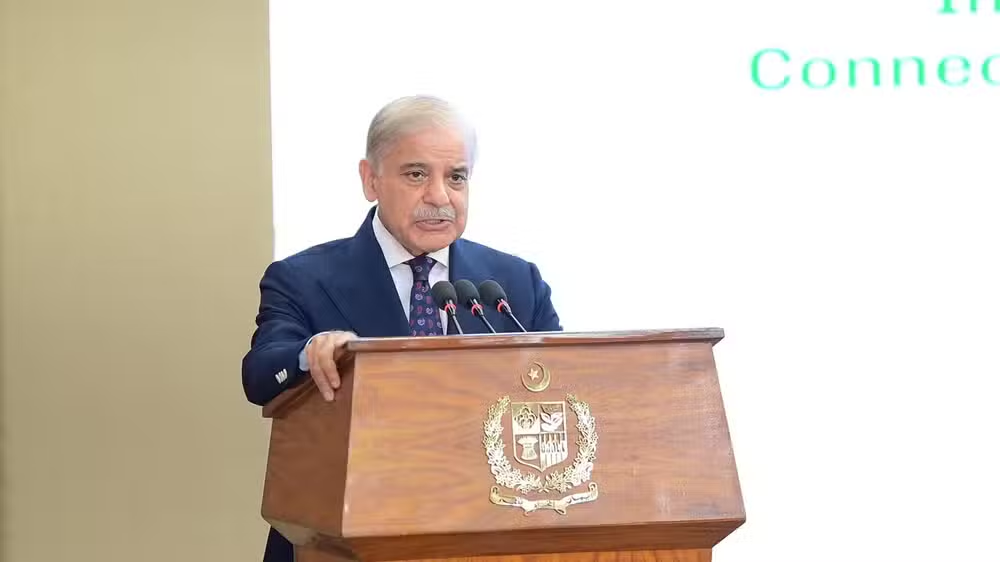
Prime Minister Shehbaz Sharif has approved a plan to increase Pakistan’s livestock exports by importing high-yield breeds, raising them at specialized farms and then exporting them, alongside a broader corporate restructuring of the sector.
The prime minister directed that specialized farms be established for livestock exports and that high-yield livestock be imported for these farms. He also ordered that livestock imported for the specialized farms be exempted from duties.
To ensure livestock raised at these farms is exported, the prime minister directed authorities to introduce a modern animal-tagging system. He also called for the livestock sector to be reorganized along corporate lines, with private-sector expertise used in reforms.
The prime minister noted that more than 60 percent of Pakistan’s agricultural sector is based on livestock and highlighted its significant export potential. He directed authorities to submit a roadmap within two weeks with specific targets for eliminating foot-and-mouth disease from the country.
He also ordered international certification of slaughterhouses and third-party validation to ensure compliance with international standards. The Ministry of National Food Security and Research was directed to work with provincial governments to eliminate livestock diseases.
The prime minister further directed authorities to improve the livestock value chain and prepare targets for exports of meat, livestock and related products.
Officials said Pakistan has around 245 million livestock animals worth about Rs. 5.5 trillion, with the sector accounting for 14.97 percent of the national economy and 63.6 percent of the agricultural economy.
Annual production stands at about 74.69 million tonnes of milk and 6.31 million tonnes of meat, while around 8 million rural households are associated with livestock. Officials said small-scale farming and fragmented supply chains remain major obstacles to fully exploiting the sector’s export potential.
Pakistan’s meat exports stood at around $530 million in 2025-26, with the bulk going to Gulf markets including the United Arab Emirates, Saudi Arabia, Kuwait and Qatar. Officials identified Malaysia, Saudi Arabia, China and other countries as potential markets for expanded exports.
The government is also working on animal disease surveillance, prevention and traceability, foot-and-mouth disease-free zones and compartments, vaccination, digital disease surveillance, export-grade farms and international health and halal certification. Other measures include feedlot farming, cold-chain infrastructure, deboning, value-added products and export infrastructure.