



There is an old rule in politics and public office: people remember what they see long before they remember the explanation.
Pakistan’s Independence Day celebrations offered a textbook example.
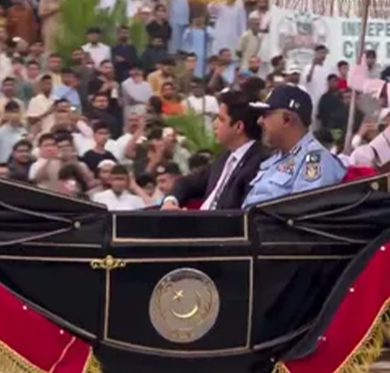
A ceremonial horse-drawn carriage entered the venue carrying Islamabad Chief Commissioner and CDA Chairman Sohail Ashraf and Islamabad Inspector General Syed Ali Nasir Rizvi. Within minutes, videos spread across social media, triggering criticism that had little to do with the officers themselves and everything to do with what the moment appeared to represent.
For many viewers, the optics suggested that two serving bureaucrats were being accorded a ceremonial status usually reserved for the country’s highest constitutional offices.
That perception became the story.
It Was Never Just About a Carriage
Had the same officers arrived in official vehicles, few would have noticed.
Instead, the ceremonial buggy became the centrepiece of the event.
State ceremonies are built on symbolism. Every detail—from seating arrangements to motorcades, salutes and ceremonial transport—signals constitutional hierarchy. Alter one symbol, and people begin asking whether the hierarchy itself has changed.
The criticism online reflected exactly that.
Many users questioned why civil servants appeared in a procession resembling those associated with national leadership. Others contrasted the display with Pakistan’s economic hardships, arguing that public officials should project restraint rather than grandeur.
Several users pointed to images of Norway’s foreign minister using commercial transport during a visit to Islamabad, drawing comparisons between modesty and spectacle.
Others mocked the scene, describing it as a “mini 23rd March parade” or suggesting that some bureaucrats had begun behaving like heads of state.
The language varied.
The message did not.
People believed the optics were out of step with both constitutional norms and the public mood.
Mohsin Naqvi’s Clarification
As criticism intensified, Interior Minister Mohsin Naqvi responded on X.
He acknowledged that the incident “was not appropriate” but said neither the IG nor the Chief Commissioner should be blamed.
According to Naqvi, the chief guest and he were delayed because of a meeting between the President and the Prime Minister. Since spectators had been waiting since 5 p.m., organisers were instructed to begin the programme rather than keep families waiting.
He also said the ceremonial carriage had originally been arranged for the chief guest, and both officers had initially resisted starting the event without senior leadership.
The explanation clarified why the decision was taken.
It did not change the image millions had already seen.
Why the Backlash Was So Intense
The episode resonated because it touched a deeper public sentiment.
Pakistanis increasingly judge governments not only by policies but also by conduct, symbolism and humility in public office.
Ceremonial protocol carries meaning. It reflects institutional order and reminds citizens that offices are larger than the individuals occupying them.
When those symbols appear blurred—even unintentionally—public reaction is swift.
In today’s digital age, a 20-second video often shapes public opinion faster than a carefully worded statement issued hours later.
By the time explanations arrive, perceptions are usually already formed.
A Lesson in Public Office
The controversy is unlikely to be remembered for procedural details.
It will be remembered for an image.
That image sparked debate not because people objected to two officers attending an Independence Day event, but because many believed the ceremony projected a level of prominence that did not align with their constitutional roles.
Intentions may have been practical.
The public reaction was emotional.
Both can be true at the same time.
For those entrusted with public office, that is perhaps the biggest lesson from this year’s August 14 celebrations: protocol is not merely ceremonial.
It is communication.
And in an era where every official moment is instantly broadcast to millions, optics can become more powerful than the explanation that follows.