




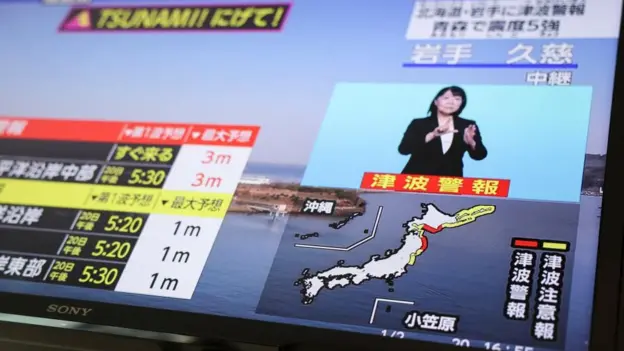
A powerful earthquake struck off the north-eastern coast of Japan on Monday, prompting authorities to issue a tsunami warning after waves were detected offshore.
According to national broadcaster NHK, tsunami activity was observed about 50 kilometres from the coastline following the quake near Iwate Prefecture. Officials warned that coastal areas could face hazardous sea conditions and urged residents to remain vigilant.
Prime Minister Sanae Takaichi appealed to people living in affected regions to immediately move to higher ground as a safety precaution while emergency monitoring continues.
Preliminary seismic data showed the earthquake occurred at a relatively shallow depth of around 10 kilometres beneath the seabed, increasing the risk of strong shaking and ocean disturbance. Tremors were felt far beyond the epicentre, including in the capital Tokyo, according to reports cited by Agence France-Presse.
Authorities also began precautionary inspections at nearby nuclear facilities. Japanese news agency Kyodo News reported that no abnormalities had been detected at nuclear plants located in Aomori Prefecture and Miyagi Prefecture.
The operator of the Fukushima Daini Nuclear Power Plant also confirmed that no irregularities had been observed following the earthquake. Safety inspections remain ongoing at the nearby Fukushima Daiichi Nuclear Power Plant, the facility that experienced reactor meltdowns after the devastating 2011 earthquake and tsunami along Japan’s eastern coastline.
The 2011 disaster forced the evacuation of thousands of residents and triggered a long-term response to radioactive contamination that took years to manage. Authorities continue to closely monitor nuclear infrastructure as a precaution while assessing the broader impact of the latest earthquake and potential tsunami risk.