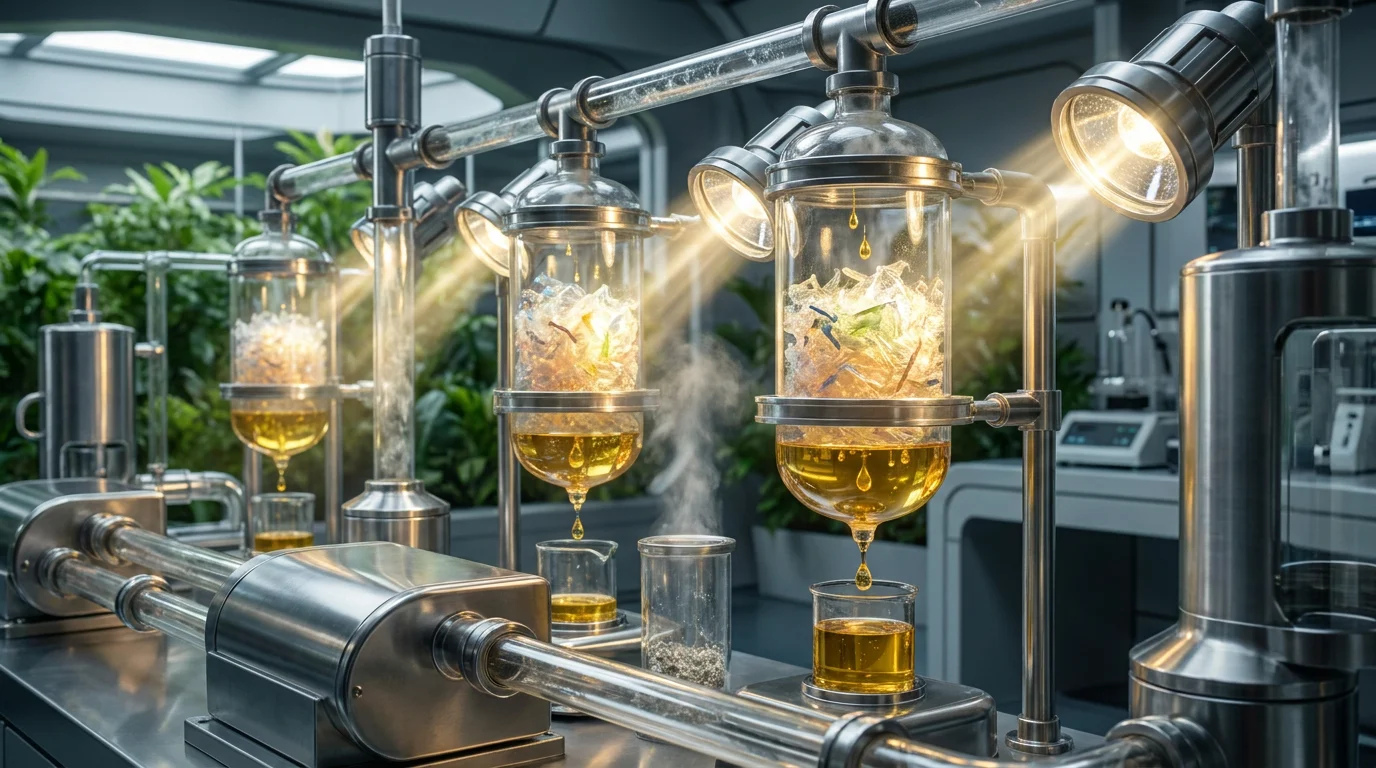
Researchers have developed a method that uses sunlight to convert plastic waste into fuels and industrial chemicals, offering a potential approach to tackling both pollution and energy demand.
The study, led by PhD researcher Xiao Lu at the University of Adelaide, focuses on a solar-powered process that breaks down discarded plastics into hydrogen, syngas, and other chemical outputs. The findings have been published in the journal Chem Catalysis.
More than 500 million tons of plastic are produced globally each year, with a significant portion ending up as waste in landfills and the environment. At the same time, global efforts to reduce fossil fuel dependence have increased interest in alternative energy technologies.
The research suggests that plastics, which contain high amounts of carbon and hydrogen, can be used as a feedstock for energy production rather than treated solely as waste.
Solar Photoreforming Process
The technique, known as solar-driven photoreforming, uses photocatalysts—materials that respond to light—to break down plastics at relatively low temperatures.
This process can produce hydrogen fuel, which emits no direct pollution during use, as well as other by-products such as hydrocarbons and organic acids used in industry.
Compared with conventional hydrogen production methods, the process may require less energy input because plastics are chemically easier to break down than water molecules.
Early experimental systems have shown that hydrogen can be produced continuously for extended periods, alongside other chemical outputs, indicating improving stability in controlled settings.
Challenges in Practical Use
Researchers say several technical barriers still need to be addressed before the technology can be scaled up.
One key challenge is the diversity of plastic waste, which includes different polymer types and chemical additives. These variations can affect how efficiently the material breaks down, making pre-sorting and treatment important.
Another limitation is the durability of photocatalysts, which must remain effective under prolonged reaction conditions. Current materials may lose efficiency over time.
In addition, separating and purifying the resulting mixture of gases and liquids requires additional energy, which can reduce overall efficiency.
Future Development
Scientists say further progress will depend on improving catalyst design, reactor systems, and process integration. Possible solutions include continuous-flow reactors and hybrid systems that combine solar energy with other energy inputs.
Researchers believe that with further development, the technology could eventually be used at industrial scale to support both waste management and clean fuel production.
The study describes the approach as still experimental but potentially significant for long-term sustainable energy systems if key technical challenges are resolved.