





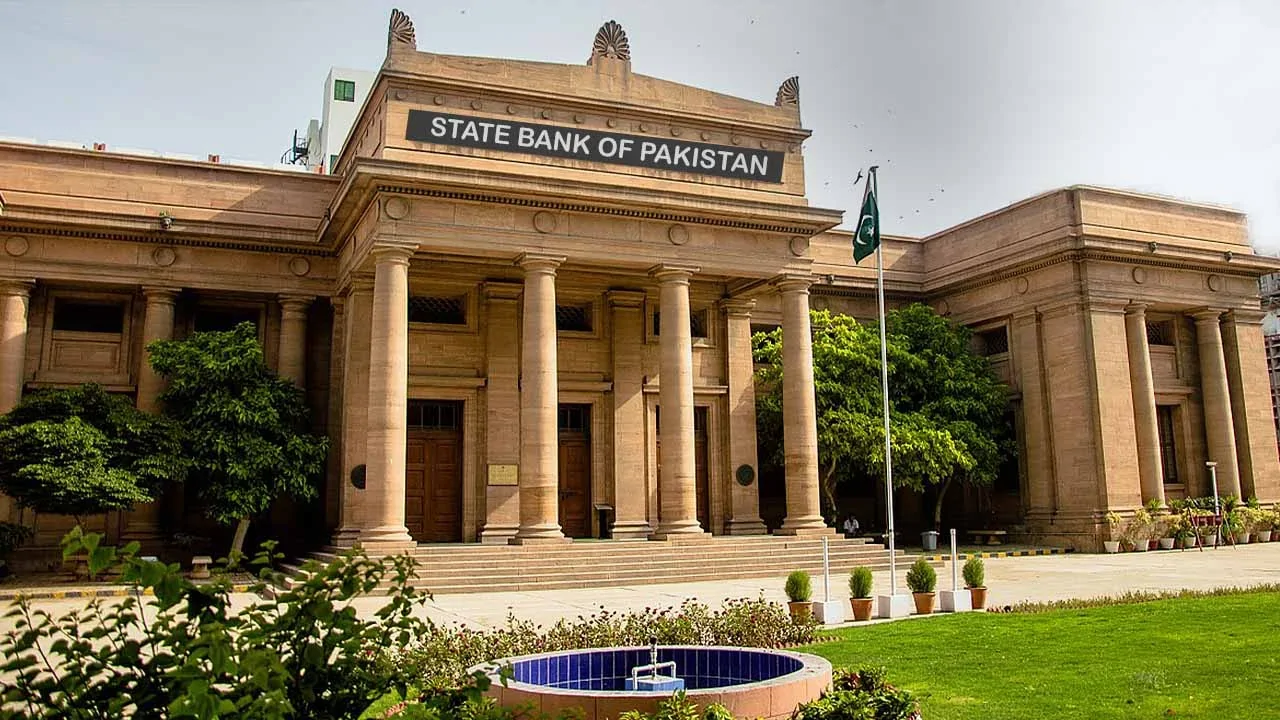
The State Bank of Pakistan (SBP) on Monday decided to keep its benchmark policy rate unchanged at 11.5 percent to start the new fiscal year 2026-27.
The Monetary Policy Committee (MPC) said this was due to the improved macroeconomic outlook despite persistent risks stemming from renewed tensions in the Middle East.
The Committee noted that the earlier de-escalation in regional conflict had lowered global oil prices and eased supply chain disruptions, supporting recent economic indicators. While headline and core inflation moderated in June, both remained elevated. At the same time, high-frequency indicators pointed to a pick-up in economic activity, and external account pressures remained contained. Based on these developments, the MPC assessed that the current monetary policy stance remains appropriate to steer inflation toward the 5–7 percent target range over the medium term.
Key Developments
Since its previous meeting, the Committee highlighted several positive developments:
- SBP’s foreign exchange reserves exceeded the end-June 2026 target of $18 billion, supported by continued FX purchases, a small current account deficit, and planned official inflows.
- Pakistan’s sovereign credit rating was upgraded to ‘B’ by Standard & Poor’s.
- Inflation expectations eased among both consumers and businesses, although confidence indicators remained mixed.
- The FBR achieved its revised FY26 tax collection target.
- The IMF raised its global inflation forecasts for CY26 and CY27 in its latest World Economic Outlook due to higher commodity prices.
Economic Activity
The MPC observed that economic activity slowed in the final quarter of FY26 due to the Middle East conflict, higher global energy prices, and government austerity measures. However, high-frequency indicators—including satellite imagery, automobile sales, cement dispatches, fertilizer offtake, and business sentiment—indicate a recovery in June.
The agriculture outlook has also improved. Higher expected sugarcane production is likely to more than offset the projected decline in cotton output. Combined with budget incentives, continued tariff rationalization, and stronger private sector credit growth, these factors are expected to support economic activity.
Accordingly, the MPC expects Pakistan’s real GDP growth to remain within 3.5–4.5 percent in FY27. However, risks from volatile commodity prices, renewed Middle East tensions, and weather-related uncertainties, including the evolving effects of El Niño, continue to cloud the outlook.
External Sector
Pakistan recorded a current account deficit of $139 million in FY26, close to the lower end of the projected range. Record-high workers’ remittances helped offset a wider trade deficit caused by the Middle East conflict, while the financial account remained in surplus.
These developments enabled the SBP to strengthen its reserves and reduce forward liabilities. However, following recent debt repayments, SBP’s FX reserves stood at approximately $17.3 billion as of July 17.
The MPC expects the current account deficit to widen moderately in FY27 as economic activity strengthens but remain within 0–1 percent of GDP. Workers’ remittances are projected to increase further, while planned official inflows and improved private inflows are expected to lift SBP’s reserves to $20.2 billion by the end of December 2026.
Fiscal Sector
The FBR met its revised FY26 tax collection target of Rs. 13 trillion, while Pakistan maintained a primary fiscal surplus for the third consecutive year. The overall fiscal deficit also narrowed significantly compared with the previous year.
For FY27, the government aims to achieve a primary surplus of 2.0 percent of GDP and limit the overall fiscal deficit to 3.6 percent of GDP. The MPC stressed that meeting these targets will require continued revenue mobilization, expenditure discipline, tax base-broadening, and reforms to reduce losses at public sector enterprises.
Money and Credit
As of July 10, broad money (M2) growth slowed to 13.2 percent year-on-year, down from 15.2 percent at the previous MPC meeting. The moderation reflected slower growth in both net domestic assets and net foreign assets.
Meanwhile, private sector credit growth accelerated to 14.9 percent, driven by stronger borrowing for working capital, fixed investment, and consumer financing. The main borrowing sectors were textiles, telecommunications, and wholesale and retail trade.
Inflation Outlook
Headline inflation eased to 11.1 percent year-on-year in June from 11.7 percent in May, mainly due to the pass-through of lower global energy prices and favorable electricity tariff adjustments. Core inflation also declined to 8.4 percent, although it remained elevated.
Food inflation, however, increased due to higher prices of wheat, wheat products, and perishable food items.
Looking ahead, the MPC expects higher global commodity prices, rising input costs, and domestic food price pressures to keep inflation above the target range in the coming months. Inflation is then projected to gradually ease and stabilize near the upper end of the 5–7 percent target range by June 2027, although the outlook remains vulnerable to global energy price volatility, administered price adjustments, adverse weather conditions, and fiscal risks.




