




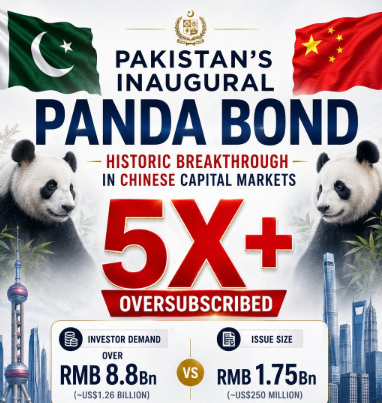
Pakistan has successfully issued its first Panda Bond, raising RMB 1.75 billion (about US$250 million) from China’s onshore capital market, marking the country’s debut sovereign borrowing in Chinese currency.
The three-year fixed-rate bond represents Pakistan’s first RMB-denominated sovereign issuance in China’s domestic bond market.
The transaction drew strong investor interest, with total bids exceeding RMB 8.8 billion (around US$1.26 billion) — more than five times the offered amount.
Key Details of the Issuance
- Size: RMB 1.75 billion (US$250 million)
- Tenor: 3 years
- Coupon rate: 2.5 percent
- Currency: Chinese yuan (RMB)
- Market: China’s onshore bond market
Demand for the single tranche surpassed Pakistan’s entire planned Panda Bond programme of RMB 7.2 billion (US$1 billion equivalent), according to official details.
Strategic Significance
The issuance provides Pakistan access to a new funding source outside traditional dollar-based borrowing markets.
Officials say the move aims to:
- diversify external financing sources,
- expand the sovereign investor base,
- deepen financial cooperation with China, and
- re-establish Pakistan’s presence in international capital markets.
The relatively low coupon rate reflects favorable pricing compared with recent external borrowing costs.
Broader Context
Pakistan has relied largely on multilateral lenders and bilateral financing in recent years. Entry into China’s domestic bond market allows Islamabad to raise funds in yuan while reducing reliance on conventional international bond markets.
The Panda Bond programme has an overall ceiling of US$1 billion, with future issuances expected subject to market conditions.