



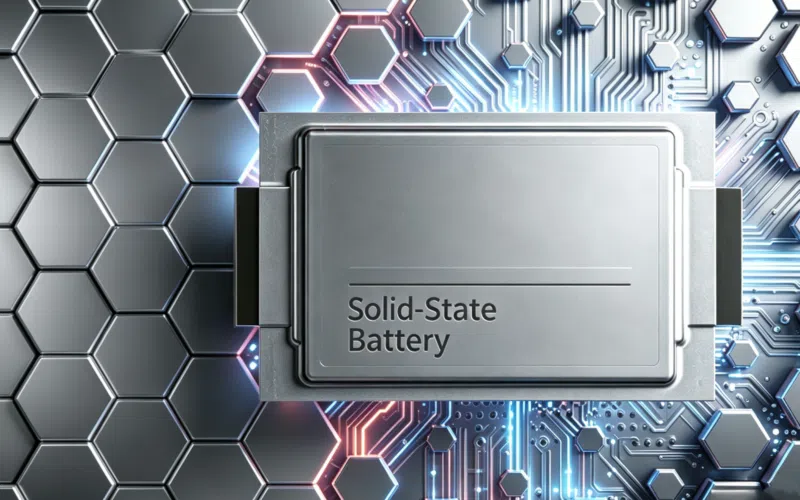
Chinese researchers at the Chinese Academy of Sciences have developed a solid-state lithium-metal battery that delivers an energy density of 451.5 Wh/kg and an estimated driving range of around 1,500 km on a single charge, according to findings published in the Journal of the American Chemical Society.
The team reported that the battery supports ultra-fast charging and discharging at a 20C rate, enabling full cycles in roughly three minutes while maintaining stable performance over extended use.
In testing, the prototype retained about 81.9% capacity after 700 cycles when paired with a 4.7V high-nickel cathode, indicating improved durability under high-power conditions.
The key advancement comes from a new electrolyte design approach called “compatibilizing-solvent plasticization.” Researchers used a temporary solvent to improve compatibility in PVDF-based polymer electrolytes during fabrication, which is later removed, leaving behind a more stable internal structure that reduces interfacial degradation with lithium-metal electrodes.
A pouch cell version of the battery, built at ampere-hour scale with a thin lithium-metal anode, achieved the same 451.5 Wh/kg energy density. The researchers also reported successful safety testing, including resistance to nail penetration.
The energy density is more than double that of typical commercial lithium iron phosphate (LFP) EV batteries, which generally operate around 200 Wh/kg, highlighting the gap between current mass-market EV technology and next-generation solid-state systems.
The development adds to rapid progress in China’s solid-state battery race, where multiple companies and institutes are targeting 400–500 Wh/kg-class cells with pilot production expected in the 2026–2027 timeframe. Despite this, LFP batteries still dominate China’s EV market due to their cost and reliability advantages.
Major players such as CATL, BYD, and others continue to scale LFP production, even as research into high-density solid-state alternatives accelerates across the industry.