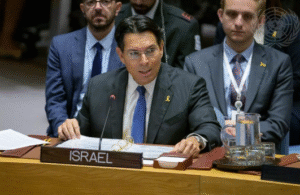




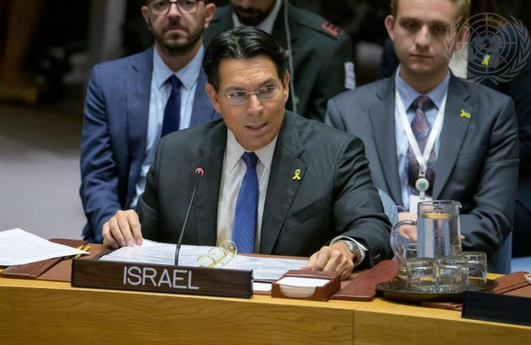
The most revealing moment of Israel’s Starlink stunt at the United Nations was not Benjamin Netanyahu holding the satellite terminal during his speech. It was what happened when Israel’s UN ambassador Danny Danon tried to take the performance directly to Iran.
An Iranian diplomat simply looked away.
Danon approached the Iranian delegation after Netanyahu’s September 24 speech and tried to hand over the same Starlink terminal used by the Israeli prime minister.
He told the Iranian representative that the device could help Iranians gain access to information and asked whether he wanted to take it back to Tehran.
The Iranian diplomat did not engage. He did not argue, accept the device or give Danon the reaction he appeared to be seeking.
Danon later posted the video with the caption, “The Iranian representative didn’t want the Starlink.”
That silence is what made the exchange so striking.
Netanyahu had already turned the Starlink terminal into a political prop during his UN address. He presented it as a tool that could help Iranians bypass restrictions and access information, while saying he would leave it at the UN for Iranian delegates who would “inevitably defect.”
Danon then went one step further.
He used the terminal to deliver an explicitly political message to an Iranian diplomat, saying it could help the Iranian people gain “freedom” and that Israel hoped for regime change in Iran.
So this was never really about giving an Iranian diplomat an internet device.
It was about creating an image.
Israel wanted a camera-ready moment in which an Iranian representative appeared to accept something associated with Netanyahu’s message. Instead, the Iranian side refused to participate.
That made the stunt considerably less useful to its intended political narrative.
The Iranian diplomat did not need a counter-speech. He did not need a confrontation. By simply refusing to engage, he denied Danon the dramatic exchange that political theatre normally depends on.
And that is perhaps the clearest lesson from the episode.
The Starlink terminal may be useful technology, but at the UN it was being used as a political symbol. Netanyahu connected it to his claims about internet restrictions in Iran, while Danon used the same device to openly talk about regime change.
Iran therefore had little reason to treat the approach as a friendly technological offer.
Accepting it would have allowed Israel to frame the moment as an Iranian representative embracing Netanyahu’s message. Engaging with Danon would have created another opportunity for Israel to dominate the exchange.
Ignoring him avoided both.
There is also an important distinction between technology and politics here.
Starlink can provide satellite internet access. But the terminal itself does not automatically turn a diplomatic confrontation into a discussion about internet freedom. Once Netanyahu and Danon attached it to a call for political change, the device became part of the Israeli political message.
The Iranian representative’s response was to reject that framing altogether.
That is why the few seconds of footage became more interesting than the carefully prepared speech surrounding it.
One side arrived with a prop and a message.
The other side offered neither a response nor the reaction the moment appeared designed to produce.
Just silence.
Iran
What is beyond dispute is the political messaging behind it.
Israel wanted to associate Starlink with Iranian internet freedom and political change. Iran’s representative refused to become part of that picture.
For all the technology on display, the most effective response required none.
He simply looked away.