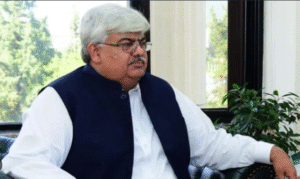




Pakistan’s claim that it has higher import duties than regional economies has been challenged by industrialist Amir Ullah Wala, who says the government is comparing different types of duties across countries.
Speaking at the 39th international conference of the Pakistan Society of Development Economists, Wala said Pakistan’s reported average tariff of 18.54 percent includes additional customs duties and regulatory duties, while the figures for India, Bangladesh and other countries cover customs duties alone.
According to World Trade Organization data cited by Wala, Pakistan’s average applied customs tariff was 10.3 percent in 2023, compared with 17 percent in India and 14.1 percent in Bangladesh.
Pakistan’s National Tariff Policy, however, puts the country’s average import duty at 18.54 percent. This comprises a 10.3 percent customs duty, a 3.65 percent additional customs duty and a 4.57 percent regulatory duty.
A Commerce Ministry spokesperson said the figure represents Pakistan’s overall average import duties. The spokesperson added that the WTO excludes para-tariffs from its simple average tariff calculations in its tariff profile reports.
Dr. Rubina Athar, a former chairperson of the National Tariff Commission who helped prepare the policy, also said the definitions used for Pakistan and other countries were not consistent. She added that the 18.5 percent figure excludes other taxes collected at the import stage, including sales tax and withholding tax.
Dr. Manzoor Ahmad, a member of the Tariff Policy Board, said the figures presented by Wala and Athar were both valid in their respective contexts.
Under the policy, Pakistan plans to reduce its average import duty rate from 20.1 percent to 9.7 percent by 2030, cutting it by about 52 percent. The proposed reductions have raised concerns among industrial groups.
Wala also argued that high import duties alone do not explain Pakistan’s weak export performance. He pointed to high electricity costs, elevated interest rates, higher taxes than regional competitors, security challenges and limited access to markets in Africa, Central Asia and South America.
The Commerce Ministry said the WTO relies on information provided by individual countries to determine their tariff rates.