




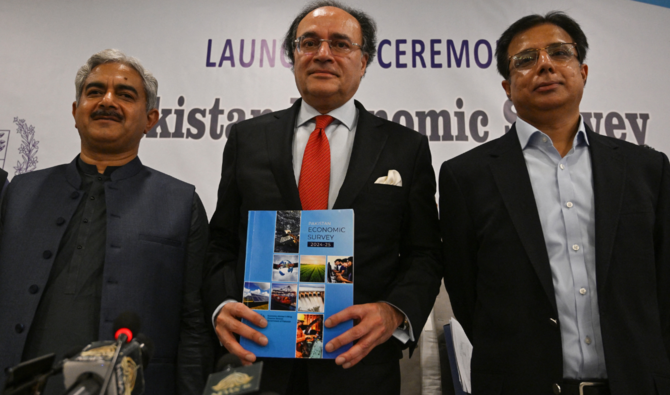
Finance Minister Muhammad Aurangzeb on Thursday unveiled the Pakistan Economic Survey (PES) for FY2025–26, highlighting an improvement in macroeconomic stability, growth recovery, and fiscal discipline over the past year.
He said the economy faced uncertainty at the start of the fiscal year but gradually stabilized despite external pressures and structural challenges.
According to the survey, Pakistan’s economy grew by 3.7 percent in FY2025–26, compared to 3.18 percent in the previous year. Growth was supported by improvements in agriculture, industry, and services, along with policy reforms under the IMF programme, exchange rate stability, and recovery after flood-related disruptions.
GDP at current prices rose to Rs126.9 trillion (US$452.1 billion), while per capita income increased to US$1,901 from US$1,751.
The services sector remained the largest contributor, expanding by 4.09 percent, followed by industry at 3.51 percent and agriculture at 2.89 percent. Large-Scale Manufacturing also recorded strong growth of 6.11 percent.
The fiscal position showed notable improvement, with the deficit narrowing to 0.7 percent of GDP during July–March FY2026 compared to 2.6 percent last year. The primary surplus rose to 3.2 percent of GDP, supported by higher revenues and reduced spending, particularly lower debt servicing costs.
Average inflation stood at 6.2 percent during the first ten months of the fiscal year, though prices rose sharply in April due to higher global oil costs and supply disruptions.
Agriculture rebounded with 2.89 percent growth, led by higher output in major crops including wheat, sugarcane, and rice, alongside gains in livestock and allied sectors.
Manufacturing expanded by 6.6 percent, with broad-based growth across 16 major industrial sectors, while mining and quarrying returned to positive territory after several years of contraction.
Investment indicators also improved, with private investment rising 12.8 percent and gross fixed capital formation increasing by 10.9 percent. National savings remained steady at 14.13 percent of GDP.
On the external front, Pakistan recorded a slight current account surplus of US$72 million, supported by strong remittances, which rose 8.2 percent to US$30.3 billion. Foreign exchange reserves improved to US$21.8 billion, while the rupee remained stable.
Public debt reached Rs83.3 trillion by March 2026, though the pace of growth slowed compared to the previous year.
Equity markets performed strongly, with the KSE-100 index gaining 18.4 percent during the period, reflecting improved investor sentiment.
The IT and telecom sector continued to outperform, with ICT exports rising nearly 20 percent and freelancer earnings increasing significantly. Pakistan also launched its first major 5G spectrum auction and approved its Artificial Intelligence Policy 2025.
Social indicators showed gradual improvement, including higher literacy and school attendance rates, while poverty and unemployment rose amid inflationary pressures and climate-related shocks.
Installed power capacity reached 49,651 MW, with renewables, hydel, and nuclear collectively surpassing thermal generation for the first time. However, climate change remained a major risk, with the 2025 floods causing widespread damage and displacement across the country.