




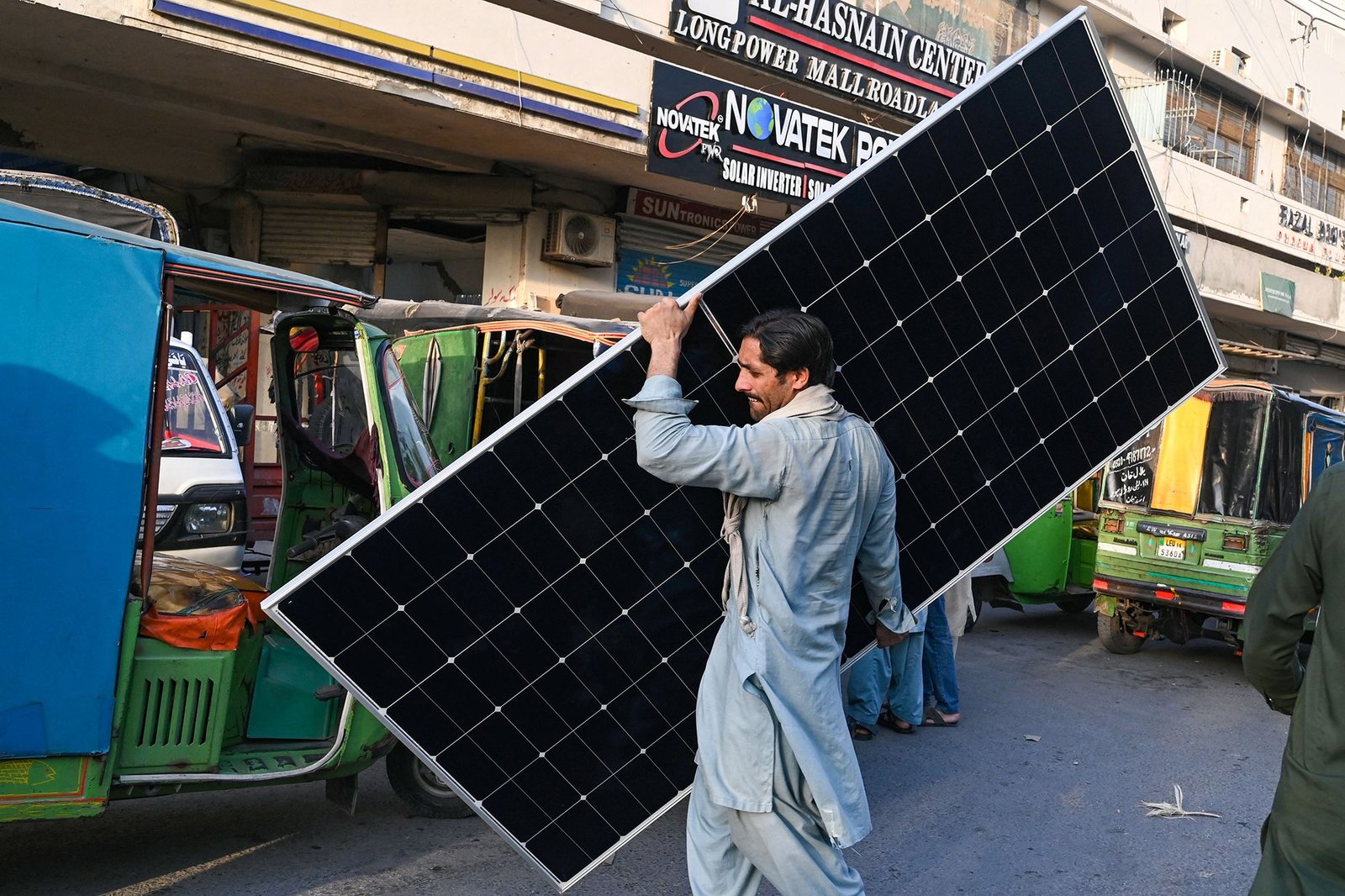
Pakistan’s solar market could see increased availability of older 585W solar panels at discounted prices as Chinese manufacturers shift toward higher-efficiency modules ahead of new mandatory standards taking effect next year.
For Pakistani buyers, this creates a key question: is a cheap 585W panel a genuine bargain, or is it leftover inventory being cleared before newer technology takes over?
China’s New Standard
China published GB 47834-2026 on June 27, 2026. The mandatory standard introduces minimum energy-efficiency requirements for crystalline-silicon photovoltaic modules and will take effect on January 1, 2027.
The new requirements will push manufacturers toward more efficient modules and could accelerate the clearance of products that no longer meet the direction of the Chinese market.
The standard is not a blanket ban on 585W panels. Its requirements are based on module efficiency and technology. However, some older 585W products with lower efficiency could face increasing pressure as manufacturers transition their production.
Why Pakistan Could See More Old Stock
China dominates global solar-panel manufacturing, while Pakistan has become a major destination for imported Chinese modules.
As manufacturers and distributors prepare for the 2027 transition, older inventory still sitting in warehouses or distribution channels will need to be sold.
Price-sensitive export markets such as Pakistan can become natural destinations for such stock, particularly when older modules can be offered at lower prices.
This could mean more aggressive discounts on 585W panels that are approaching the end of their mainstream production cycle.
The Problem With Buying Only on Price
A cheaper panel is not automatically a bad panel. An older module can continue generating electricity for years.
The concern is the long-term economics.
Solar systems are typically expected to operate for 20 years or more. If a particular panel model is discontinued soon after installation, buyers could eventually face difficulty finding identical replacement modules.
Newer panels may also offer higher efficiency at competitive prices, making older modules less attractive for future installations and reducing their resale value.
Replacement and Warranty Risks
A discontinued panel can create problems if one module fails several years into a system’s life.
Finding another panel with matching dimensions, voltage, current and electrical characteristics may become difficult as newer generations replace older products.
Warranty support also deserves scrutiny. Buyers should establish whether the seller is an authorized distributor, whether the exact model is still being manufactured and how warranty claims will be handled if the product disappears from the market.
A long warranty printed on a brochure is less useful if obtaining a replacement becomes difficult.
Check More Than the 585W Rating
Consumers should not choose a panel solely because it carries a 585W rating.
Before purchasing, buyers should check:
- Module efficiency
- Cell technology
- Manufacturer and exact model
- Manufacturing date
- Degradation rate
- Warranty terms
- Seller or distributor authorization
- Serial-number verification
- Availability of replacement modules
- Price compared with newer-generation panels
Efficiency is particularly important for households with limited roof space. A newer, more efficient panel can potentially deliver greater output from a similar installation area.
What a Big Discount Could Mean
If a 585W panel is being offered substantially below newer alternatives, the discount may simply reflect normal competition. But it could also indicate stock that a distributor needs to clear.
That distinction matters.
Buyers should ask why the panel is cheaper, how long the model has been in production, when it was manufactured and whether the manufacturer is still actively producing it.
Pakistan already has substantial solar-panel inventory following exceptionally high imports in recent years. This means older products can remain in local distribution channels even as global manufacturers move toward newer models.
The Bottom Line
The issue is not that all 585W panels are outdated or unsuitable for Pakistan.
The risk is that some older 585W models could become increasingly difficult to source, replace or resell as the global market shifts toward higher-efficiency technology.
For consumers planning to use a solar system for decades, the cheapest panel is not necessarily the best-value panel.
Before buying a heavily discounted 585W module, buyers should find out whether they are getting a genuine bargain—or simply helping someone clear old inventory.