



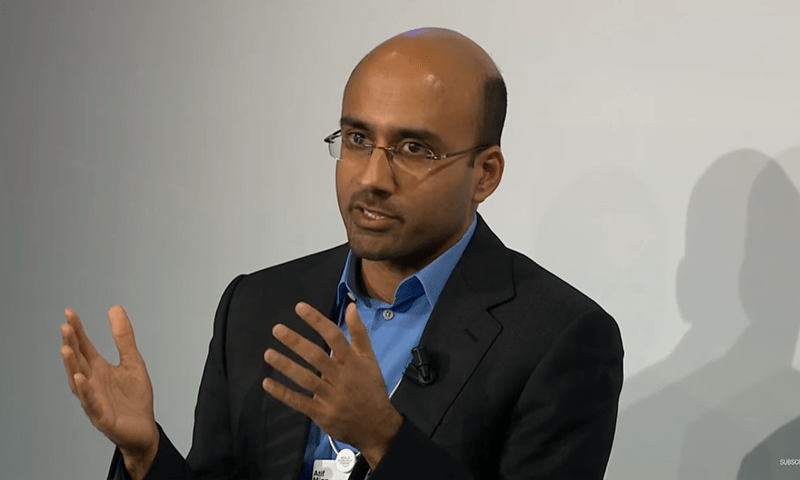
Renowned economist Atif Mian has criticised Pakistan’s reliance on workers’ remittances, arguing that the country’s economic model encourages people to leave so the elite can benefit from the foreign currency they send home.
Speaking at the Pakistan Conference at Harvard University, the Princeton University professor said this approach needed to change. He was part of a panel that included Finance Minister Muhammad Aurangzeb, former State Bank of Pakistan Governor Reza Baqir and Nobel laureate Daron Acemoglu.
A clip of Mian’s remarks has gained traction on social media.
Atif Mian Questions Pakistan’s Reliance on Remittances
Mian described Pakistan’s dependence on remittances as “particularly dangerous” from a political economy perspective.
He noted that remittances are now almost equal to the country’s exports and account for close to 10 percent of gross domestic product (GDP). Despite this dependence, he said, policymakers continue to celebrate inflows and propose increasing them further.
Mian argued that a successful economy should reduce its reliance on remittances as a share of GDP because more people would have opportunities to build their lives at home rather than seek work abroad.
‘So We Can Live Off DHA Better’
Mian also questioned the government’s reported plan to train 50,000 nurses for Japan, asking how sending trained workers overseas could be considered a growth strategy.
He argued that the policy creates incentives to educate skilled workers for foreign labour markets, with the money they send home supporting an economic system that benefits certain sections of society.
“That incentive is structural. They will send back money, and so we can live off DHA better as a result of that. That thinking has to change,” he said.
His reference to DHA highlighted his criticism of an economic model in which wealth generated through property and other domestic assets can benefit from money earned abroad, rather than from expanding productive industries.
Strong Rupee Puts Exporters at a Disadvantage
Mian linked the remittance model to Pakistan’s struggle to expand exports. He argued that an overvalued exchange rate effectively penalises exporters, while benefiting wealthy groups whose income comes from sectors such as real estate.
A stronger rupee increases the purchasing power of those earning in local currency when they buy imported goods or travel abroad. However, it can make Pakistani products more expensive for foreign buyers and weaken exporters’ competitiveness.
Mian said Pakistan needs to change these incentives, drawing a comparison with China’s approach to building export capacity.
His argument centres on a broader economic challenge: creating an environment where investment and wealth are increasingly driven by productive businesses and exports, rather than property gains and remittances alone.