



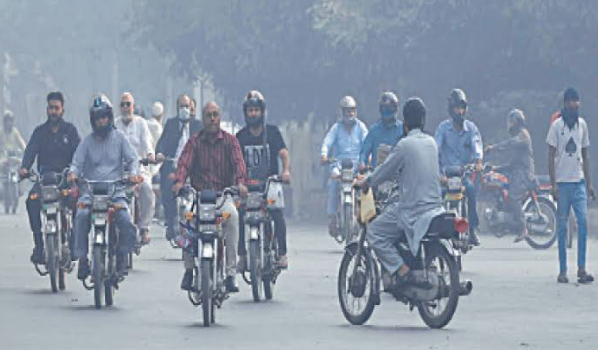
Punjab government has blamed motorcycles for contributing significantly to Pakistan’s smog and air pollution, but inconsistencies in official data have raised questions over the basis of the claim.
The Urban Unit has identified motorcycles as one of the major sources of transport-related pollution, largely because of their large numbers. However, the government appears to lack reliable data on how many motorcycles are actually active on Pakistan’s roads.
Automotive industry veteran and road safety expert Tauqeer Ahmed has highlighted a major gap in official estimates. Government data up to March 2026 puts the number of registered two-wheelers at 31.9 million, while the Pakistan Climate Prosperity Plan, issued by the Ministry of Finance on April 29, 2026, estimates that only about 10 million motorcycles are operating on the roads.
Ahmed said such a large difference raises questions about the accuracy of Pakistan’s vehicle data and its use in policymaking.
He also questioned claims linking motorcycles to pollution through two-stroke engines. According to him, production of two-stroke motorcycles in Pakistan stopped at least in 2006, making it unlikely that large numbers of these vehicles are still being used regularly nearly 20 years later.
Questions have also been raised over the estimated contribution of motorcycles to fine particulate pollution, particularly PM2.5. Data from the Urban Unit’s Air Pollution Emission Inventory of Punjab does not clearly establish the scale of motorcycle emissions compared with other pollution sources.
Pakistan’s First Biennial Update Report, prepared with the Ministry of Climate Change under the UN climate framework, estimates that motorcycles contribute less than 1 percent of the country’s total greenhouse gas emissions.
Experts argue that imposing new taxes, restrictions or other measures on motorcycles based on uncertain data could disproportionately affect low- and middle-income households, many of which depend on two-wheelers for daily transportation.
Such measures could also add pressure on Pakistan’s already struggling automotive industry, increase regulatory uncertainty and discourage investment.
A nationwide assessment of active vehicles and their actual emissions is therefore needed before motorcycles are subjected to further measures under Pakistan’s smog and air pollution policies.