




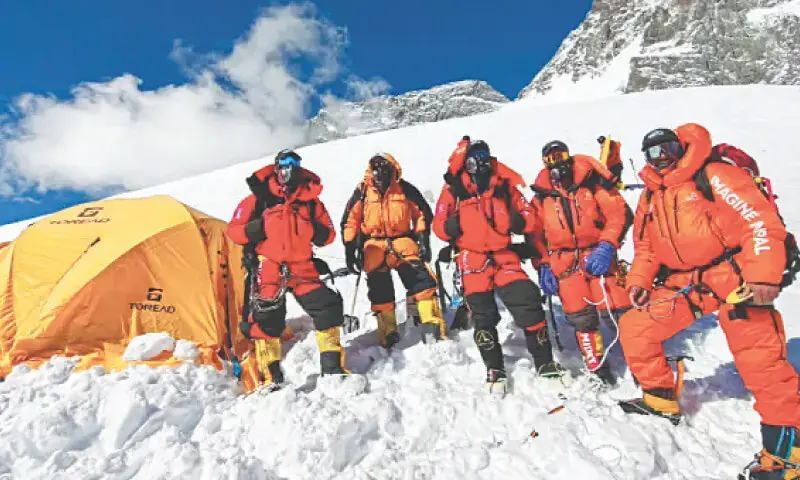
Renowned Nepali mountaineer Nirmal “Nims Dai” Purja is among 10 climbers missing after a massive avalanche struck their expedition on Broad Peak in the Karakoram range, the Alpine Club of Pakistan (ACP) confirmed late Thursday, triggering a frantic international rescue effort involving military helicopters and fellow climbers descending from nearby peaks.
The expedition, led by the 43-year-old record-breaking mountaineer, was attempting to scale the 8,047-metre peak when the avalanche hit. The team has remained out of communication since the incident, the club said.
“Every possible effort is being made to ensure that helicopter support and all available rescue resources are mobilised at the earliest opportunity, subject to weather and operational conditions,” the ACP said in a statement.
The 10-member team includes five Nepalese climbers, a Pakistani, an Omani, an American, a Chinese national, and one other foreigner. The ACP identified the missing as: Nadhira Ahmed Abdullah Al Harthy (Oman), Sohail Sakhi (Pakistan), Wang Zhong (China), Mallory Geis (United States), Nirmal Purja (Nepal), Pur Bahadur Gurung “Yukta” (Nepal), Kili Pemba Sherpa “Kilu” (Nepal), Nima Sherpa (Nepal), Nawang Thindu Sherpa (Nepal), and Gyalu Sherpa (Nepal).
The group comprised guides and foreign clients climbing under three Nepali expedition operators: Elite Exped, Seven Summit Treks, and Imagine Nepal.
Rescue operation underway
Two army rescue helicopters carrying personnel and specialised equipment have been dispatched to the mountain, the ACP said, supporting ground teams operating in an extremely difficult, high-altitude environment where weather, thin air, steep terrain, and unstable snow can severely restrict rescue operations.
Nepal’s Mountaineering Association is coordinating with the ACP, while Nepali climbers already in the K2 and K3 areas have begun descending to assist with the search. Some Sherpa climbers based around K2 were also heading toward Broad Peak, according to Nepali officials.
Mingma Gyabu Sherpa, a Nepali lawmaker and business associate of Purja, said climbers from the area were moving to help, with members of Imagine Nepal also assisting in the effort.
There were reports of possible movement detected by a tracking device associated with Purja, but the data reportedly reflected movement recorded earlier and has not been confirmed as evidence that he is alive.
‘Space for hope has become very narrow’
Two bodies have been recovered so far, and identification is underway, according to Thaneshwar Guragain, general manager of Seven Summit Treks. Asked about the chances of finding other climbers alive, Guragain told Nepal’s Kantipur daily that they were “slim,” adding that “the space for hope has become very narrow.”
Avalanche survival depends heavily on how quickly buried climbers can be located and dug out, while conditions at more than 6,000 metres make prolonged rescue efforts extraordinarily difficult.
A record-breaking career
Purja, who served with Britain’s Brigade of Gurkhas before joining the Special Boat Squadron of the Royal Marines, has broken multiple climbing records since becoming a full-time mountaineer and tour guide.
He shot to global fame after climbing all 14 of the world’s “eight-thousanders” — peaks above 8,000 metres — in just six months and six days between April and October 2019, a record that dramatically compressed a feat that had traditionally taken climbers years.
In 2021, along with a team of nine other Nepalese climbers, Purja completed the first winter ascent of K2, the world’s second-highest peak and one of the most dangerous mountains to climb.
The dangers of Broad Peak
Broad Peak’s 8,047-metre summit places it firmly in the so-called “death zone,” where atmospheric oxygen is only a fraction of that at sea level. At those elevations, the human body deteriorates rapidly even when climbers are acclimatised, and helicopters have limited operating capabilities.
The avalanche itself creates additional hazards: unstable snow can trigger secondary slides, while buried climbers may be difficult to locate beneath deep snow and debris.