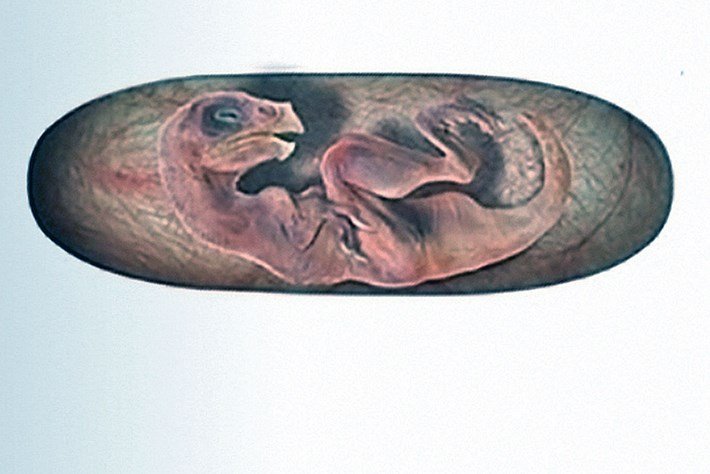
Scientists in South Africa have identified a 250-million-year-old fossil egg containing an embryo, providing the first clear evidence that early mammal ancestors reproduced by laying eggs.
The discovery comes from the Karoo Basin and involves a fossil of Lystrosaurus, an early herbivorous synapsid that lived during the Early Triassic period and is considered part of the evolutionary line leading toward mammals.
Using high-resolution CT scans and synchrotron imaging, researchers confirmed the presence of an unborn embryo preserved inside one of three examined specimens. The fossil shows the embryo in a curled position, consistent with being inside an egg at the time of preservation.
Key anatomical features also indicate that the individual had not yet hatched, including underdeveloped jaw structures that would have prevented feeding.
The findings resolve a long-standing question in paleontology about whether early therapsids laid eggs. According to the researchers, this evidence strongly supports egg-laying reproduction in mammal ancestors.
The study also suggests that these ancient eggs were likely soft-shelled, which may explain why fossilized eggs from this period are extremely rare, as they are less likely to survive geological processes.
Lystrosaurus was a tusked, herbivorous creature measuring up to 2.4 meters in length and is known from fossil records across Africa, India, China, Antarctica, and Europe—providing key evidence for the existence of the ancient supercontinent Pangaea.
The discovery is being described as a major milestone in understanding the reproductive evolution of early vertebrates and the origins of mammalian life.