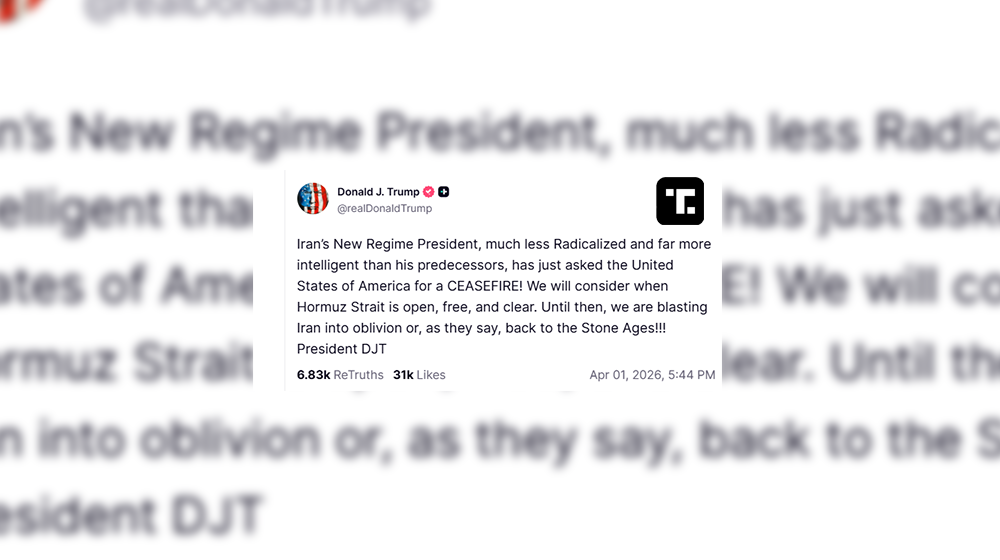
U.S. President Donald Trump ignited global attention on April 1 when he posted on Truth Social that Iran’s new leadership had asked the United States for a ceasefire in the ongoing conflict. Trump’s statement — released without formal verification from Iran — said the Iranian request would only be considered once the Strait of Hormuz was “open, free and clear.” He added that until that condition is met, U.S. military operations against Iran would continue.
In the post, Trump described the unnamed Iranian leader as “much less radicalized and far more intelligent than his predecessors,” though it was unclear whom he was referring to given Iran’s political structure. Trump wrote that Iran had “just asked the United States of America for a ceasefire,” but insisted that the U.S. would not halt its actions until the strategic waterway was reopened.
Iran’s Foreign Ministry swiftly responded to Trump’s claim, strongly denying the ceasefire request. A spokesperson for the ministry described the assertion as “false and baseless,” contradicting the U.S. narrative. Tehran emphasized that no official approach had been made asking for a halt in hostilities, intensifying confusion over the conflicting statements.
The exchange comes amid sustained tensions between the United States and Iran, with military engagement, regional instability, and control over critical energy routes remaining central issues. Analysts note that the contrasting claims — one asserting a diplomatic overture, the other rejecting it outright — add to the uncertainty surrounding the conflict’s trajectory.