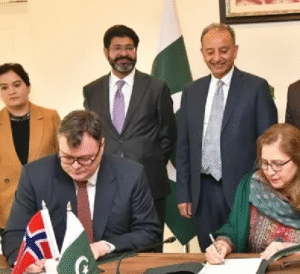




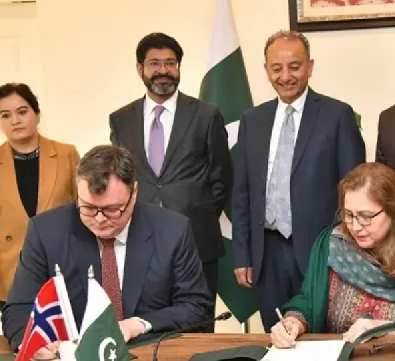
Pakistan has signed its first bilateral carbon market agreement under the Paris Agreement, formally entering the global carbon trading system and opening new avenues for climate finance and green investment.
The agreement, concluded with Norway under Article 6.2 of the Paris climate framework, enables Pakistan to develop projects that reduce greenhouse-gas emissions and convert those reductions into tradable carbon credits for international buyers.
The partnership allows emission-reduction initiatives across renewable energy, climate-smart agriculture, transport and waste management sectors to generate verified carbon credits. These credits can be transferred internationally, creating a new source of foreign investment linked to environmental performance.
The deal represents a shift from climate policy planning to practical implementation, positioning Pakistan as an active participant in global carbon markets. Authorities are now moving to establish monitoring systems, reporting mechanisms and regulatory structures required to operationalise carbon trading.
Pakistan’s mitigation potential remains significant, particularly in solar and wind energy expansion, sustainable farming practices, cleaner transport solutions and improved waste management systems. Officials expect the framework to attract project developers, international investors and technology partnerships aimed at accelerating low-carbon growth.
For Norway, the agreement supports its broader climate neutrality ambitions by enabling the purchase of internationally transferred mitigation outcomes beyond its national emission targets. The country plans to channel climate finance into large-scale programmes capable of delivering measurable emission reductions while supporting sustainable development.
Norway has already entered similar carbon market partnerships with several developing nations and aims to secure millions of carbon credits by 2030. Pakistani authorities have been encouraged to develop a pipeline of renewable energy and industrial decarbonisation projects eligible for future cooperation.
The agreement is expected to strengthen Pakistan’s access to global climate finance, expand private-sector participation in green projects and help the country advance its climate commitments while pursuing sustainable economic growth.