




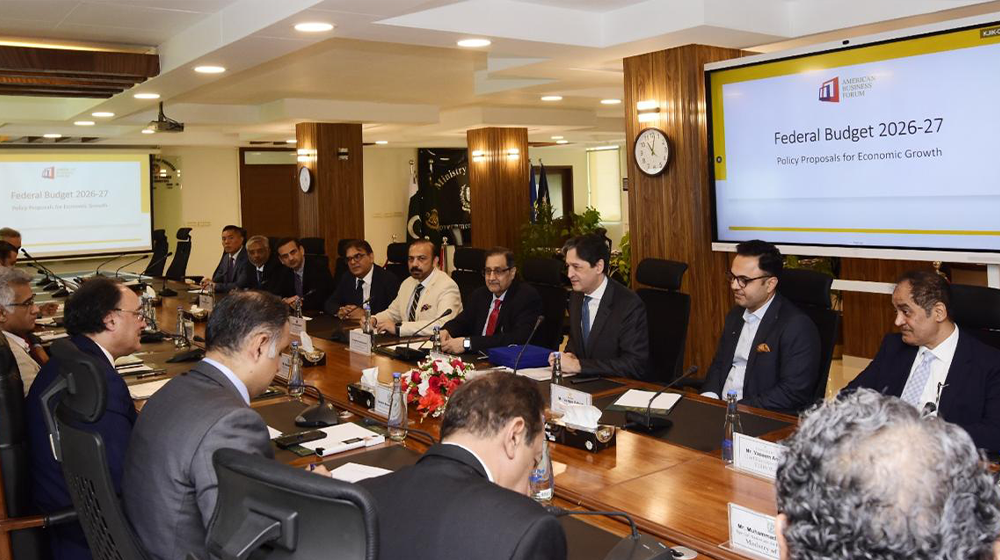
Finance Minister Senator Muhammad Aurangzeb on Thursday assured American investors that the government is moving toward a comprehensive reset of Pakistan’s business environment, with upcoming fiscal and regulatory reforms aimed at improving investment confidence and supporting export-led growth.
The assurance came during a meeting at the Finance Division with a delegation of the American Business Forum (ABF), led by its President Osman Khalid Waheed, where government officials and corporate leaders exchanged views on economic reforms, taxation, and barriers affecting foreign investment.
During the discussion, the Finance Minister highlighted signs of macroeconomic stabilization, pointing to improvements in fiscal management, external sector indicators, and continued engagement with international financial institutions. He said the government remains focused on sustaining economic stability while advancing structural reforms necessary for long-term growth.
Aurangzeb also briefed participants on efforts to resolve energy-sector challenges, strengthen supply chains, and improve coordination across ministries through a high-level oversight mechanism chaired by him. He stressed that authorities are actively monitoring economic developments and maintaining close coordination with both domestic and international stakeholders.
Representatives of the American Business Forum welcomed the reform direction but emphasized the need for policy consistency and predictability to encourage long-term investment decisions. The delegation presented proposals covering tax rationalization, reduced compliance requirements, export incentives, and smoother foreign exchange inflows.
Industry representatives highlighted sector-specific concerns. Pharmaceutical executives noted that regulatory improvements alone could significantly expand Pakistan’s pharmaceutical exports—from roughly $1 billion to as much as $3–5 billion—without requiring additional fiscal incentives. They called for modernized regulations and stable pricing frameworks to unlock growth.
Participants from the IT and services sectors raised issues related to foreign exchange retention, digital payment infrastructure, corporate card usage, and taxation of cross-border transactions. They urged the government to simplify procedures and accelerate digital reforms to support export-oriented industries.
Business leaders also stressed the importance of continued modernization of customs and tax administration, improved digital systems, and streamlined regulatory processes to enhance ease of doing business.
Responding to the proposals, the Finance Minister reaffirmed the government’s commitment to creating a business-friendly policy framework. He said several recommendations are already under consideration and indicated that the upcoming federal budget would reflect progress toward tax simplification and regulatory reform.
Aurangzeb added that economic policymaking is increasingly being aligned with value creation, export expansion, and investment promotion, while ongoing efforts to separate tax policy formulation from revenue collection aim to enhance transparency and administrative efficiency.
Both sides agreed to maintain regular engagement to support Pakistan’s economic transformation and attract greater foreign investment, with the Finance Minister inviting further actionable proposals from the business community in light of emerging regional opportunities.
The ABF delegation included senior representatives from multinational and domestic companies across pharmaceuticals, manufacturing, consumer goods, food services, and technology sectors.