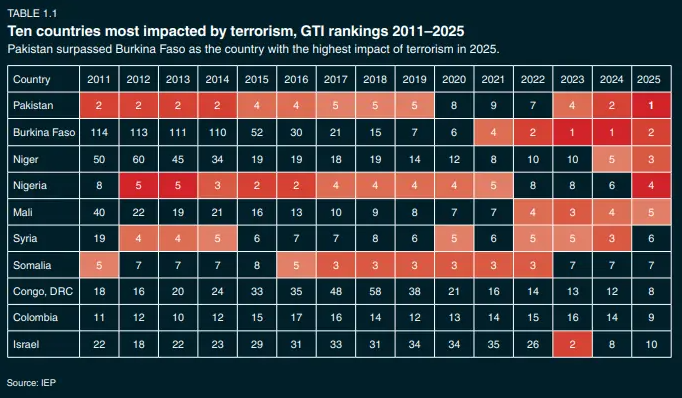
Pakistan has been ranked the most terrorism-affected country in the world for the first time, according to the Global Terrorism Index 2026 released by the Institute for Economics and Peace.
The country recorded 1,139 terrorism-related deaths in 2025, reflecting a 6 percent increase from the previous year. The report also documented 1,045 terrorist incidents across the country during the same period.
The index evaluates 163 countries, covering the vast majority of the global population, based on the number of attacks, fatalities, injuries, and hostage situations.
Rising Violence and Security Challenges
The report highlights that Pakistan’s security situation has deteriorated amid growing militant activity and regional tensions, particularly with Afghanistan. Groups such as the Tehreek-i-Taliban Pakistan and the Balochistan Liberation Army were identified as key drivers of violence.
Terror-related deaths have reached their highest level since 2013, continuing a six-year upward trend in fatalities. The report also notes that while the total number of attacks saw a slight decline, the severity and impact of incidents increased.
TTP Emerges as Deadliest Group
The TTP has been identified as the most lethal group operating in Pakistan and among the deadliest globally. It was responsible for 637 deaths in 2025, accounting for more than half of all terrorism-related fatalities in the country.
The group carried out 595 attacks during the year, marking a 24 percent increase compared to 2024. All incidents were reported within Pakistan, with a concentration in areas near the Afghan border.
Since 2009, the TTP has been responsible for the majority of terrorist attacks in Pakistan, far exceeding the activity of other groups.
Sharp Rise in Hostage Incidents
Hostage-taking incidents rose sharply, increasing from 101 in 2024 to 655 in 2025. A major contributing factor was a large-scale incident involving the Jaffar Express, which significantly raised the total number of hostages recorded in the country.
Afghanistan Factor and Regional Impact
The report links Pakistan’s security challenges to developments in Afghanistan, noting that changes there have strengthened militant groups and expanded their operational capacity. This has contributed to increased cross-border activity and intensified violence in the region.
Global Trends
Globally, terrorism declined, with deaths falling by 28 percent to 5,582 and attacks decreasing by nearly 22 percent. However, the majority of fatalities were concentrated in a small number of countries.
Pakistan, along with Burkina Faso, Nigeria, Niger, and the Democratic Republic of Congo, accounted for a large share of global terrorism-related deaths. The report also highlights a rise in incidents in Western countries, though numbers remain relatively low compared to high-risk regions.
Pakistan’s Position
Pakistan had ranked second in the previous year’s index, with terrorism deaths rising significantly in 2024. Its move to the top position reflects continued escalation in violence and security challenges over recent years.