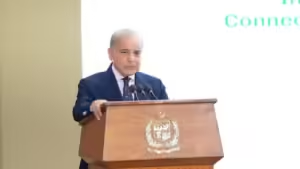





The federal government has established a dedicated SME Finance Task Force to improve access to bank financing for small and medium enterprises (SMEs) as part of its broader strategy to boost private sector lending and accelerate economic growth.
Finance Minister Senator Muhammad Aurangzeb announced the initiative while addressing the Pakistan Banking Summit 2026 in Karachi on Tuesday.
The task force will be led by the State Bank of Pakistan (SBP) and include senior representatives from the Pakistan Banks’ Association (PBA), Small and Medium Enterprises Development Authority (SMEDA), chambers of commerce and industry, and the Ministry of Finance.
According to the Finance Division, the body will recommend practical measures to expand SME financing and improve access to credit across Pakistan’s banking sector.
The finance minister said greater lending to SMEs, exporters, agriculture, manufacturing, construction, housing, and the IT sector is essential for achieving sustainable economic growth, adding that SME financing should become an industry-wide priority rather than the responsibility of only a few banks.
He also noted that the FY2026-27 federal budget includes allocations to support these priority sectors.
Highlighting the country’s economic outlook, Aurangzeb said Pakistan closed the last fiscal year with a primary surplus, one of its lowest fiscal deficits in recent years, improved debt indicators, a sustained current account surplus, record remittance inflows, higher foreign exchange reserves, and renewed access to international capital markets, including the country’s inaugural Panda Bond issuance.
He reiterated the government’s commitment to export-led growth through structural reforms, saying the FY2026-27 budget introduced tax and financing measures to enhance competitiveness, encourage investment, support exporters and manufacturers, and provide relief to salaried taxpayers. He also announced plans to introduce a Medium-Term Tax Strategy to provide greater policy certainty for businesses.
The finance minister said the government is modernizing tax administration through technology to reduce human intervention, improve transparency, and strengthen taxpayer confidence.
He added that the government will continue expanding risk-sharing and partial credit guarantee schemes for SMEs and small farmers while promoting targeted financing for export-oriented sectors. The government also plans to diversify borrowing through non-bank financing channels and deepen domestic debt capital markets to create more room for private sector lending.
Aurangzeb also highlighted reforms in privatization, climate finance, digital assets, and financial innovation, noting that the recently enacted Virtual Asset Act 2026 provides a regulatory framework for digital assets. He said the government is exploring innovative financing options, including the tokenization of sovereign debt, while emphasizing the need to strengthen cyber resilience across Pakistan’s financial system.